
Kalasarpa Yoga
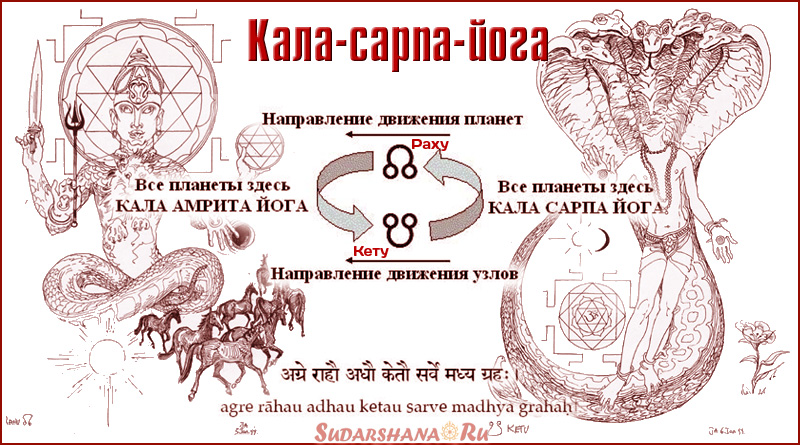
Kalasarpa yoga arises when all seven planets are placed on one side of the Rahu/Ketu axis. This yoga foretells discord, difficulties and destruction, but it has no effect at all on mental abilities and hardly afflicts the length of life. Its effects are most palpable in the planetary periods of the Lunar nodes and during the transits of Rahu and Ketu over the Lagna, the Sun and the Moon. At such times restrictions manifest, failures and setbacks pursue the person, and his well-being deteriorates. Sudden rises and falls in the career are possible, especially in the mahadashas and antardashas of Rahu and Ketu. A favourable aspect on the Lagna or the Lagnesha neutralises this yoga. It is also cancelled by the placement of Rahu in the nakshatra Vishakha, especially in the range 200°-206°40′ (the sign of Libra).
There is a view that if all the planets are squeezed between Rahu and Ketu, then a Kalasarpa yoga is formed, whereas if they are between Ketu and Rahu (that is, after the Lagna Ketu comes first and Rahu after it), then another combination takes place — Kala-amrita yoga. This yoga is favourable, but its positive effects will not manifest if another planet is joined with Ketu.
Sri Govind Swarup Agarwal — «Vedic Astrology»
Visti Larsen — «KALA SARPA YOGA»

Kala Sarpa Yoga is one of the most sinister and most discussed combinations in Vedic astrology. It is not mentioned in a single classical text, and yet in its degree of significance it yields nothing to the Nabhasa Yogas, which are given far from the least role in a horoscope.
The best-known measures for combating the ruinous effect of this Yoga are the daily wearing of a Navaratna (a bracelet consisting of the stones of all 9 planets) and making a pilgrimage to the «Kala Hasti» temple, which is in the Indian state of Andhra Pradesh.
This Yoga considerably restricts the freedom of the native (makes him dependent), giving very short periods of success, up to the age of forty (at this age the Yoga as it were loses its strength — its life cycle comes to an end). This Yoga may be called by different names; it is given the names of the Divine Serpents in accordance with one of its 12 varieties. There is much confusion on the question of the formation of Kala Sarpa Yoga — when it is formed and when it is not. Below is a description of it corresponding to the astrological tradition of Sri Achyuta Das.
Kala Sarpa Yoga is formed if all the planets are between the two lunar nodes — between Rahu and Ketu. The nodes thus split the zodiac in two. The planets may be placed in the direction from Rahu to Ketu, or from Ketu to Rahu. That is, this Yoga has two kinds. The node placed in front of the planets will be the head; if the head is Rahu, then the Yoga will be called Kala Sarpa Yoga. If, however, the head is Ketu, then the Yoga will be called Kala Amrita Yoga.
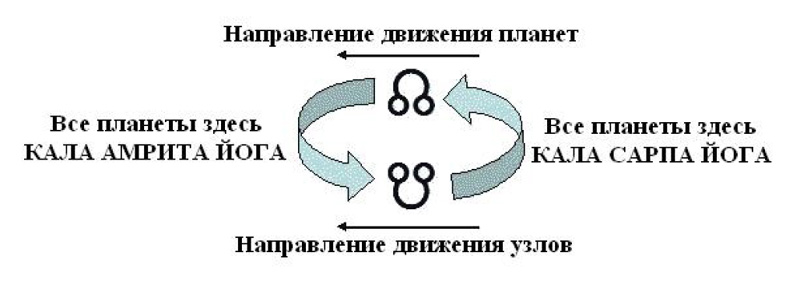
The difference between these types can be judged from their names:
— Kala Sarpa Yoga pushes the native towards obtaining sensory experience; in other words, it favours a materialistic view of life.
— Kala Amrita Yoga, on the contrary, favours a choice in favour of spirituality.
The attractiveness of one path or the other depends on the native’s personal views, and this Yoga will bring him suffering even before he is able to make his choice. The native’s life will pass against a background of tormenting restrictions and of oscillation between two extremes — a materialistic life and a life of the spirit — until the corresponding age. The sphere of life that restricts the native’s freedom is indicated by the houses in which the nodes are placed.
In what way this Yoga will fetter a person can be learned by examining the location of the nodes from the Lagnesha, the Arudha Lagna, the Karaka Lagna and so on.
The Rahu/Ketu axis and the sphere of restrictions
1st/7th — Reputation, health, aspirations, relationships and cooperation
2nd/8th — Wealth, family, debts and illnesses
3rd/9th — Disputes, aggression, higher education, outlook
4th/10th — Home, property, happiness, work and profession
5th/11th — Children, subordinates, like-minded people, planning for the future
6th/12th — Illnesses and recovery, and also enmity
The native’s dependence, arising from the restrictions caused by the influence of Maya upon his consciousness, manifests as an inability to carry out what he has conceived. As a result Satya, or the true state of things (represented in the birth chart by Surya and Chandra), frightens the native to the same degree as he strives to carry out his plans. The direction of his thoughts is set by the node standing at the head of the Yoga: Rahu (in the case of Kala Sarpa Yoga) and Ketu (in the case of Kala Amrita Yoga).
Just as sunlight disperses darkness, so truth removes falsehood; it is truth that is able to break the fetters of Kala Sarpa / Amrita Yoga. The houses of truth are the 1st and the 7th; they symbolise the descent into this world <birth> and the departure from it <death> respectively. Planets placed in the 1st or 7th house from the corresponding nodes, or in the 1st or 7th house from the Lagna, are able to neutralise this Yoga and to establish truth.
If the Yoga is destroyed by a malefic planet, then the attainment of truth is bound up with fear and may bring grief or the complete loss of the sense of happiness. If, however, the Yoga is destroyed by a beneficent planet, the attainment of truth will be accompanied by happiness and satisfaction, and the dependence will be removed.
Having encountered a Kala Sarpa / Amrita Yoga, an astrologer should always recommend the application of corrective measures corresponding to that auspicious planet which destroys the Yoga. Otherwise failures will constantly pursue the native. If, however, no beneficent planet destroys the Yoga, it is necessary to strengthen the strongest guru planet: Jupiter or Venus — these Gurus <preceptors> are able to free the native from the enslaving influence of this Yoga.
This is especially important in the case where the Kala Sarpa Yoga is formed at a solar eclipse; then the Sun is in extreme need of the saving blessing of Brihaspati (Jupiter). Similarly, if a Kala Amrita Yoga is formed at a lunar eclipse, the Moon needs to secure the support of Shukracharya (Venus). Moreover, in both cases one may seek the saving blessing of both Gurus at once, of Jupiter and Venus at the same time.
For protection against the ruinous influences of Kala Sarpa / Amrita Yoga, besides obtaining the blessings of Jupiter and Venus, the native may carry out worship of the corresponding Devata belonging to the group of the Mahavidyas. The Mahavidya whom the native worships will remove the Avidya caused by the presence of the Kala Sarpa / Amrita Yoga, and in addition to this will improve his well-being.
Graha — Mahavidya — Nama Mantra
Sun — Matangi — Om matangyai namah
Moon — Bhuvaneshwari - Om bhuvanesvaryai namah
Mars — Bagalamukhi — Om bagalamukhyai namah
Mercury — Parasundari — Om parasoundaryai namah
Jupiter — Tara — Om tarayai namah
Venus — Kamalatmika — Om kamalatmikayai namah
Saturn — Dakshinakali — Om daksinakalike namah
Rahu — Chhinnamasta — Om cinnamastayai namah
Ketu — Dhumavati — Om dhumavatyai namah
From my own experience I have become convinced that all the above methods of removing the negative effect of Kala Sarpa Yoga work reliably…
Visti Larsen — «KALA SARPA YOGA» (translation — Oleg Patrikeev)
The varieties of Kala-sarpa yoga
Information for reflection and for checking the position of Rahu and Ketu in the presence of a Kala Sarpa Yoga in practice.
1. Ananta Kala Sarpa yoga.
Rahu is in the 1st house and Ketu in the 7th house, and all the planets are placed on one side of the Rahu-Ketu axis.
Ananata, or Ananta Shesha, is the divine Serpent on which our universe rests.
This yoga gives mixed results: the person will be successful as a politician, journalist, writer or philosopher, and may acquire a Name and Fame. But he will not have happiness in married life.
2. Takshaka Kalsarpa yoga.
Rahu is in the 7th house and Ketu in the 1st house, and all the planets are placed on one side of the Rahu-Ketu axis.
Takshaka is the one who cuts off, cuts away or separates. A name of Vishvakarma, the divine carpenter or builder. A serpent, the son of Kadru, and a lord of serpents.
The results of this combination are similar to Ananta kalsarpa yoga.
3. Kanktuk Kalsarpa Yoga
Rahu is in the 8th house and Ketu in the 2nd house, and all the planets are placed on one side of the Rahu-Ketu axis.
This type of person may become a successful scientist, researcher or tantrik. But he will be of poor origin or weak by nature.
4. Kulika Kalsarpa Yoga.
Rahu is in the 2nd house and Ketu in the 8th house, and all the planets are placed on one side of the Rahu-Ketu axis.
Kulika is a brown eight-headed serpent with a crescent moon on its head.
The results of this combination are similar to Kanktuk kalsarpa yoga.
5. Mahapadma Kalsarpa Yoga.
Rahu is in the 6th house and Ketu in the 12th house, and all the planets are placed on one side of the Rahu-Ketu axis.
The person will become a Jyotishi or an Advocate, but he will have a dangerous illness.
6. Sheshanaga Kalsarpa yoga.
Rahu is in the 12th house and Ketu in the 6th house, and all the planets are placed on one side of the Rahu-Ketu axis.
The person will become a Jyotishi or an Advocate, but he will have a dangerous illness.
7. Padma Kalsarpa Yoga.
Padma means «lotus». It is also the name of one of the Serpents.
Rahu is in the 5th house and Ketu in the 11th house, and all the planets are placed on one side of the Rahu-Ketu axis.
This person will have a child after certain problems, and will also have obstacles in education, but earns from shares or lotteries. He may acquire a name in the field of art.
8. Vishakta Kalsarpa Yoga.
Rahu is in the 11th house and Ketu in the 5th house, and all the planets are placed on one side of the Rahu-Ketu axis.
Similar to Padma kalasarpa yoga.
9. Pataka Kalsarpa yoga.
Rahu is in the 10th house and Ketu in the 4th house, and all the planets are placed on one side of the Rahu-Ketu axis.
A person with this combination feels difficulties in working in his place of birth and obtains good fortune outside his place of birth, but he is usually physically weak.
10. Shankhapada Kalsarpa yoga
Rahu occupies the 4th house and Ketu the 10th, and all the planets are placed on one side of Rahu and Ketu
Similar to Pataka Kalsarpa yoga.
11. Shankhachuda Kalsarpa yoga
Rahu is in the 9th house and Ketu in the 3rd house, and all the planets are placed on one side of the Rahu-Ketu axis
This type of person will make journeys around the world; emigration or work abroad is likely. He will be a leader and a fighter in life, an author of works or capable of new discoveries in his field of activity. But this type of person has certain mental problems, and their fortune grows after the death of the father.
12. Vasuki Kalsarpa yoga.
Rahu is in the 3rd house and Ketu in the 9th house, and all the planets are placed on one side of the Rahu-Ketu axis
All the planets are placed from the 3rd to the 9th house, between Rahu and Ketu. It is held that such a person is very brave and wealthy, will make a journey around the world (or will travel a great deal), will be courageous and at the same time inventive, holds a high post, but has poor health.
One of the outstanding scholars who has devoted his work to the study of Kalasarpa Yoga is Professor Rama Palaniappan.
Professor Rama Palaniappan began his study of astrology at the age of 14. He studied at the best Vedic universities of the country, and in 1965 he himself began teaching astrology at the Universities of Trivandrum, Hyderabad and Madurai. Today Rama Palaniappan is known as the author of many books on astrology, intended both for a wide readership and for practising specialists. He is also the creator of a unique series of video textbooks and self-study courses devoted to the most varied aspects of astrology. Today we shall put several questions about Kalasarpa Yoga to Professor Rama Palaniappan.
Tell us, what prompted your interest in the phenomenon of Kalasarpa Yoga?
Kalasarpa Yoga was present in the horoscopes of many of my relatives; incidentally, this planetary combination is often inherited. Thus Kalasarpa Yoga can be found in my own horoscope and in the horoscopes of my father, my aunt and my grandfather. When I was still a child, my family paid great attention to carrying out corrective measures aimed at minimising the negative influence of Kalasarpa Yoga, since because of it my aunt’s marriage was being delayed. They turned to various temples in Rameshwaram, Kalahasti and other towns. All this took place before my eyes, and I had the opportunity to observe how the various types of Kalasarpa Yoga influence people’s lives. I then decided to devote myself to the study of this many-sided phenomenon, in the hope that if I discovered the possibilities of correcting the influence of Kalasarpa Yoga, this would bring enormous benefit to all humanity.
So what is Kalasarpa Yoga?
Kalasarpa Yoga is an extremely unfavourable placement of the planets, one of the heaviest of the Nabhasa yogas formed with the participation of all the planets. It may lead to physical ailments, congenital defects of development, moral instability, a lack of fortune in one’s affairs, and betrayal by those close to one. Kalasarpa Yoga is formed when all the planets of the horoscope are placed between Rahu and Ketu. The positive influence of Kalasarpa Yoga may be expressed in the fact that a person with such a placement of the planets will be especially hard-working; he strives to obtain new knowledge and may attain success in everything connected in one way or another with philosophy, administration, education and so on. Moreover, people with Kalasarpa Yoga in their horoscope may fulfil in the course of their life all their desires, both on the material and on the spiritual plane.
“Kala” is translated as “time”, “Sarpa” as “serpent”, and “Yoga” as “combination”; thus the presence of Kala Sarpa Yoga indicates that the soul is held captive by the Serpent of Time because of its former karmic debts. Such a placement of the planets may indicate unusual or unexpected situations that a person will meet with in life because of the karma of former incarnations.
Please tell us how Kalasarpa Yoga is formed.
The classical shlokas describe Kalasarpa Yoga as follows: “Rahu must be in front of the Ascendant and Ketu behind it; all the planets must stand between them, and none of them must be in conjunction with Rahu or Ketu”.
A modern researcher from Kerala, the editor of the journal Jyotisha Masika, Mr K.K. Karap, gives a broader definition of Kalasarpa Yoga:
All the planets must stand between Rahu and Ketu, and not one house between Rahu and Ketu must remain empty; that is, for a Kalasarpa Yoga to be formed the planets must form an unbroken chain.
The Ascendant may either be part of the chain or lie outside it.
Rahu or Ketu may stand in the 1st house; at the same time the placement of planets in the 1st house does not by itself form a Kalasarpa Yoga.
There are two kinds of Kalasarpa Yoga: “Anuloma” and “Viloma”
“Anuloma” as a rule leads to excellent results, while “Viloma” is for the most part negative.
Anuloma is characterised by the placement of Rahu in front of the ascendant within 6 houses, with Ketu standing behind all the planets. The owner of this type of Kalasarpa Yoga will be able to attain great success in life. (if the movement of the planets is considered anticlockwise, then all the planets are between Ketu and Rahu)
Viloma is characterised by the placement of Ketu in front of the ascendant within 6 houses, with Rahu standing behind all the planets. This type of Kalasarpa Yoga is especially unfavourable. (if the movement of the planets is considered anticlockwise, then all the planets are between Rahu and Ketu)
How can other planets influence the formation of Kalasarpa Yoga?
Provided that all the planets of the horoscope are placed between Rahu and Ketu, their particular combinations may affect the activity of Kalasarpa Yoga in different ways:
If the Sun stands in the 8th house from Rahu, or when Rahu or Ketu stand in the 8th house from the Moon, the Kalasarpa Yoga is activated.
If Rahu or Ketu stand in the 6th, 7th or 8th house from the ascendant, the influence of Kalasarpa Yoga will be especially strong.
If Rahu or Ketu stand in a Kendra, the negative influence of Kalasarpa Yoga prevails.
If Rahu or Ketu stand in a Trikona, the influence of Kalasarpa Yoga will be more positive.
Depending on whether the planets follow after Rahu or after Ketu, these combinations are named Kalasarpa or Kalaamrita Yoga.
Tell us, what exactly is the difference between Kalasarpa Yoga and Kalamrita Yoga?
Both Yogas are formed if all the planets of the horoscope stand between Rahu and Ketu. Some authors maintain that Kalasarpa Yoga belongs to the unfavourable planetary combinations of Viloma, while Kalamrita Yoga, as Anuloma, has a largely positive effect on the life of the owner of the horoscope. In the southern states of India there is a view that if Rahu is moving towards the point of its exaltation and all the other planets of the horoscope are behind it, such a placement of the planets may give a positive effect on the life of the owner of the horoscope. If Rahu is moving towards the point of its debilitation and all the other planets are behind it, such a placement of the planets may have an unfavourable effect on the life of the owner of the horoscope.
One school of astrology holds that if the ascendant, the Sun, the Moon or any other planet comes out of the chain of the Kalasarpa Yoga, then its influence is completely neutralised, while another school of astrology insists that the neutralisation of Kalasarpa Yoga is possible only in the case where two or more planets are outside the chain.
What influence can Kalasarpa Yoga have?
Since the Nodes of the Moon are connected with karmic attributes, Kalasarpa yoga implies a certain restriction, irrespective of the other indications in the birth chart. Kalasarpa Yoga is as a rule most active in people between the ages of 39 and 45.
If the ascendant is not engaged in the formation of the yoga and falls outside the Rahu-Ketu axis, the unfavourable influence of Kalasarpa Yoga will be partly weakened.
Unlike other planetary combinations, Kalasarpa Yoga is formed by the lunar nodes and does not contribute either to enrichment or to a worsening of one’s material position. This yoga affects all the planets of the horoscope, which must be between the lunar nodes, and indicates that in this life the person will reap the fruits of the karma of former incarnations.
If a person suffers because of sins committed in former incarnations (Sanchita Karma), while in this incarnation he performs good deeds (good Prarabdha Karma), and Kalasarpa Yoga is present in his horoscope, then gradually, in the course of his life, his sufferings will diminish. The owner of such a horoscope will live a good worldly life surrounded by family and children.
If Rahu or Ketu is in conjunction with any planet in the ascendant or in the 7th house from the ascendant, this partly neutralises the negative effect of Kalasarpa Yoga, since a Raja Yoga is formed in the corresponding house. The owner of such a horoscope may expect good or bad situations depending on the placement of the lords of the houses and of the ascendant.
The influence of Kalasarpa Yoga is also minimised if three or more planets stand in exaltation or in a Parivartana Yoga, or if the rulers of the 2nd, 4th, 9th and 10th houses are placed in a Trikona or a Kendra while not being debilitated, not being in hostile houses and not being aspected by unfavourable planets.
A Kalasarpa Yoga formed during the transits of Rahu and Ketu may lead to abrupt climatic changes and natural disasters. In accordance with the postulates of Vedic Astrology, the placement of Uranus, Neptune and Pluto is not taken into account when calculating the influence of Kalasarpa Yoga.
What other types of Kalasarpa Yoga can you distinguish?
Since Rahu and Ketu are placed at an angle of 180° to one another, they can form 12 different types of Kalasarpa Yoga.
Ananda Kalasarpa Yoga: Rahu stands in the ascendant, Ketu occupies the 7th house, and the other planets are placed between them. Possible effect: obstacles on the way to progress, a late marriage, poor health of the spouse, unhappiness in marriage. Problems pursue the person up to the age of 27, after which the situation changes for the better, which favours his spiritual development.
Kulika Kalasarpa Yoga: Rahu occupies the second house, Ketu stands in the 8th house, and the other planets are placed between them. Possible effect: material difficulties, loss of an inheritance, the debts of the parents, poor health, an absence of support from relatives, missed opportunities because of the peculiarities of one’s temperament or of carelessly spoken words. Problems pursue the person up to the age of 33, after which the situation changes for the better.
Vasuki Kalasarpa Yoga: Rahu stands in the third house, Ketu occupies the 9th house, and the other planets are placed between them. Possible effect: problems from brothers and sisters, difficult relations with the parents, excessive modesty, a lack of confidence in one’s own powers, low social standing, weak authority. Problems pursue the person up to the age of 36, after which the situation changes for the better.
Shankhaphala Kalasarpa Yoga: Rahu occupies the fourth house, Ketu stands in the tenth house, and the other planets are placed between them. Possible effect: difficulties on the material plane because of the situation in the family or of susceptibility to bad habits. A lack of purposefulness. Good fortune in work, business and professional activity. Problems pursue the person up to the age of 43, after which the situation changes for the better.
Padma Kalasarpa Yoga: Rahu stands in the fifth house, Ketu occupies the 11th house, and the other planets are placed between them. Such a combination of planets indicates bad karma on the part of the person or of his parents in past incarnations. Problems are possible in all aspects of life, an absence of good fortune, a hard life for the parents after the birth of such a child; the birth of children will be delayed, or they will not be able to succeed in their activity; the birth of children out of wedlock is not to be excluded, along with poor health, the loss of an inheritance and poverty. Problems pursue the person up to the age of 48, after which the situation changes for the better. Some of the owners of such a placement of the planets end their life outside their homeland, in distant countries.
Mahapadma Kalasarpa Yoga: Rahu stands in the sixth house and Ketu in the twelfth, and the other planets are placed between them. The heaviest variety of Kalasarpa Yoga; it affects all aspects of life. Possible effect: an abundance of enemies, a difficult financial position, disappointments in life, involvement in unlawful activity, imprisonment and so on. Problems pursue the person up to the age of 54, after which the situation changes for the better.
Takshata Kalasarpa Yoga: Rahu occupies the seventh house and Ketu stands in the first house, and the other planets are placed between them. Possible effect: problems in family life, an inclination towards philosophy, the occult sciences and black magic. If the other planets are favourably placed, such a person may become a saint and enjoy authority in society. Good abilities for administration and opportunities for career growth in that direction. Unexpected changes in life at the age of 27, and a renunciation of worldly life after 60.
Karkotaka Kalasarpa Yoga: Rahu stands in the eighth house, Ketu occupies the 2nd house, and the other planets are placed between them. Possible effect: an absence of happiness in family life, losses in business and professional activity, an excessive taste for sensual pleasures, problems with the law, minor accidents, extravagance. Problems pursue the person up to the age of 33, after which the situation changes for the better.
Shankhachuda Kalasarpa Yoga: Rahu occupies the ninth house, Ketu stands in the third house, and the other planets are placed between them. Possible effect: problems in business, problems in dealing with people of high position. The owner of such a horoscope has to fight actively for his rights; he may suddenly gain popularity and just as suddenly lose his social position without any visible reason. Problems pursue the person up to the age of 36, after which the situation changes for the better.
Ghataka Kalasarpa Yoga: Rahu stands in the tenth house, Ketu occupies the 4th house, and the other planets are placed between them. Possible effect: insults from those around one, problems with professional activity, with one’s material position, with family life, with real estate and with means of transport. Problems pursue the person up to the age of 42, after which the situation changes for the better.
Vishadhara Kalasarpa Yoga: Rahu occupies the 11th house, Ketu stands in the fifth house, and the other planets are placed between them. Possible effect: the owner of such a horoscope has few children, relations with the children are difficult, and there are material difficulties. They may live permanently far from their homeland. Problems pursue the person up to the age of 48, after which the situation changes for the better.
Shesha-naga Kalasarpa Yoga: Rahu stands in the 12th house, Ketu occupies the sixth house, and the other planets are placed between them. Possible effect: excessive thriftiness, an interest in politics, imprisonments, secret and open enemies. Problems pursue the person up to the age of 54, after which the situation changes for the better.
Please tell us about the corrective measures intended to lessen the negative effect of Kalasarpa Yoga.
To neutralise the negative effect of Kalasarpa Yoga many corrective measures are used, including the recitation of mantras, the performance of yajnas, homas and japa, and the wearing of particular precious stones. There are special temples (as a rule connected with the cult of the serpent) in which the corresponding rituals can be performed.
The owner of a Kalasarpa Yoga must also learn to live in harmony with the Universe. The law of karma cannot be annulled; however, the negative influence of Kalasarpa Yoga can be considerably reduced with the help of various corrective measures, of rethinking one’s place in life and of renouncing an egocentric approach.
To minimise the influence of Kalasarpa Yoga the following corrective measures are recommended:
Wearing on the little finger a silver ring in the form of two serpents, beginning at dawn on a Wednesday. Two silver serpents may also be placed on the altar or in the place where you pray and recite mantras. At dawn each day recite 108 times “Om Rahave Namah” and “Om Ketave Namah”.
Offering urad dal grain to a poor person on a black cloth for 72 Wednesdays.
Bathing for 72 Wednesdays in one and the same water, into which the petals of the Palash (Palach) flower are placed daily, while reciting the mantras “Om Rahave Namah” and “Om Ketave Namah” 108 times each.
Keeping a fast on the day of Naga Panchami and reciting the Naga Gayatri 1008 times.
Corrective measures to neutralise the negative effect of Kalasarpa Yoga are carried out during Naga Panchami, on the day before Maha Shivaratri, on Amavasya (the moonless day, the 30th lunar day) if this day falls on the nakshatras Ardra, Swati or Shatabhisha, and also on Amavasya (the 30th lunar day) or Purnima (the full Moon) if they fall on a Wednesday.
A dialogue with the professor of Vedic astrology Rama Palaniappan
Kala Sarpana Yoga — an indicator of the neglect of one’s duty in life…
This yoga, or combination of planets in the birth chart, is very well known among astrologers. Two shadow planets, Rahu and Ketu, are represented in the image of a Serpent, and therefore this yoga is called sarpana — serpent, kala — time, the serpent of time… and such a position, when all the planets are as it were held captive by Rahu and Ketu, can have a strong negative and even critical influence on many spheres of our life.
As we know, there are two kinds of these positions, Kala Sarpana and Kala Amrita; both bring torment, purification and problems… But Kala Amrita prompts a person to rid himself of his problems through self-development and spiritual practice, while Kala Sarpana prompts him to deal with his problems by resolving to act on the material level…
There are 12 positions of Kala Sarpana and 12 positions of Kala Amrita, and in order to select a neutralisation one must study each type: which houses the yoga affects, which aspects they receive, and whom Rahu and Ketu aspect, whether there are any planets that can destroy this yoga… there are a great many factors that must be studied…. one thing is clear, that such a position at the moment of birth indicates that the child, on the level of karma (action), on the level of jnana (knowledge and convictions), and on the level of upasana (faith), committed sinful acts, and did so because of his demonic convictions and actions and guided by the knowledge of a demonic culture… and therefore the upaya, the correction, must touch all these three stages of existence….
On the level of action — service and the giving of alms; on the level of knowledge — an understanding of the laws of karma and of the human way of thinking and culture; and on the level of faith — the development and acceptance of knowledge about God, an understanding of one’s place in the Universe, in God’s creation, of one’s dependence on Him, and the development of good relations with Him…
Rahu and Ketu always move retrograde — against the ordinary movement of all the other planets; they have a demonic influence, which is not always bad, since this influence always helps us to uncover, purify and organise our sinful desires and our animal nature.