
Nakshatra Krittika
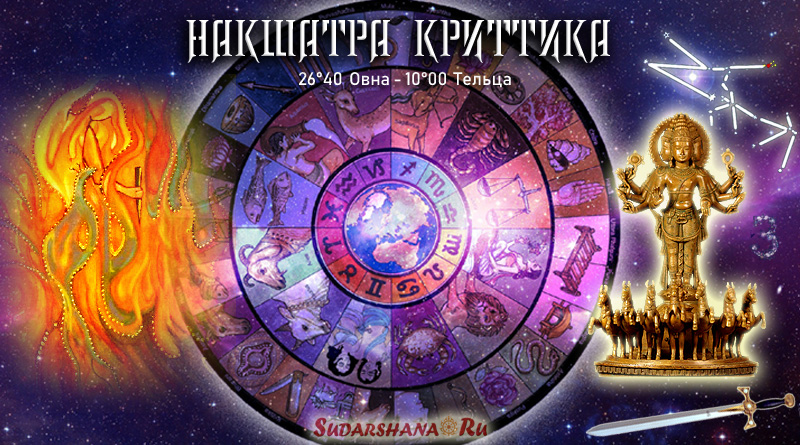
The nakshatra Krittika (3rd of the 27 nakshatras, 26° 40′ of Aries — 10° 00′ of Taurus). The symbol of Krittika is a sharp, razor-like instrument, and its deity is Agni, the sacred fire. Mythologically, Krittika (the Pleiades) are the foster mothers of Karttikeya, one of the sons of Shiva.
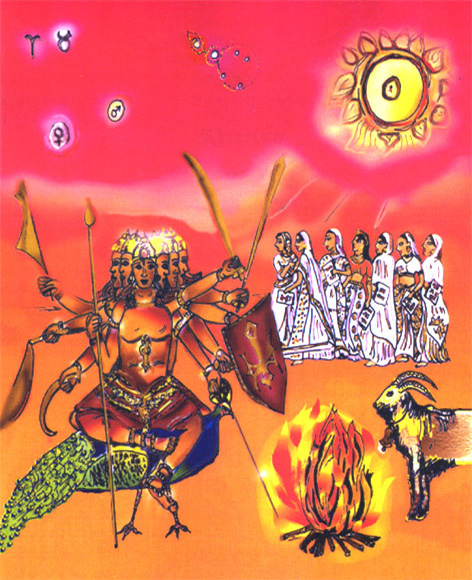
Krittika people are by nature abrupt, caustic and shrewd. The razor symbolism also speaks of sharp or honed instruments and of the work performed with their help, for example, the preparation of animal skins for leather and fur goods. Sharp objects — pens and quills for writing, sewing needles, and also sharp instruments such as drills — are all ruled by Krittika.
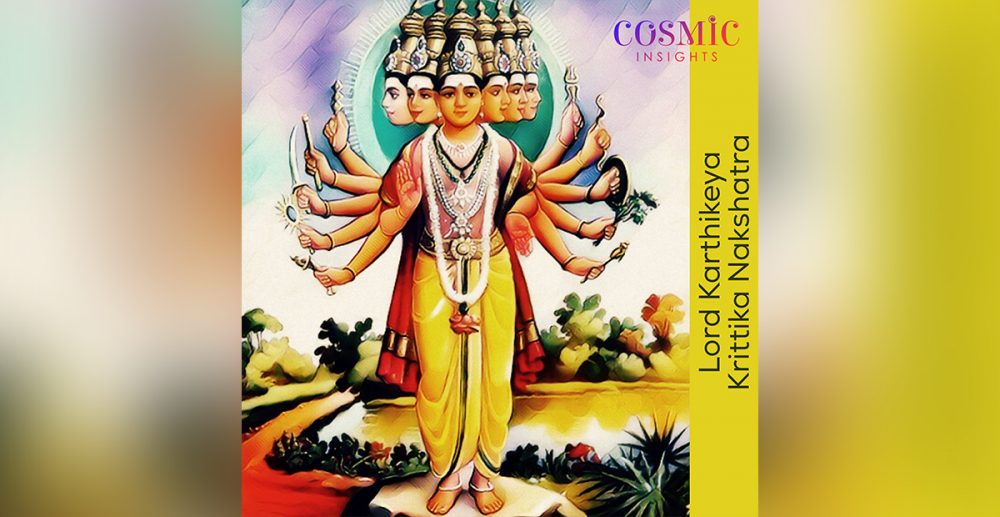
The weighty office of Karttikeya — commander-in-chief of the celestial army — says directly that Krittika has power over war, battles, armies and disputes, and the fact that Karttikeya is famed for monumental heroic deeds implies that his nakshatra too is always in view and that aspirations and projects going beyond the bounds of the ordinary are inherent in it. Since the body of Karttikeya and his armour shine like the Sun, Krittika also rules gold and is in a certain way connected with wealth. The mythological plots connected with it tell, among other things, of adoption, foster motherhood and of the responsibility laid upon one to give patronage to others.
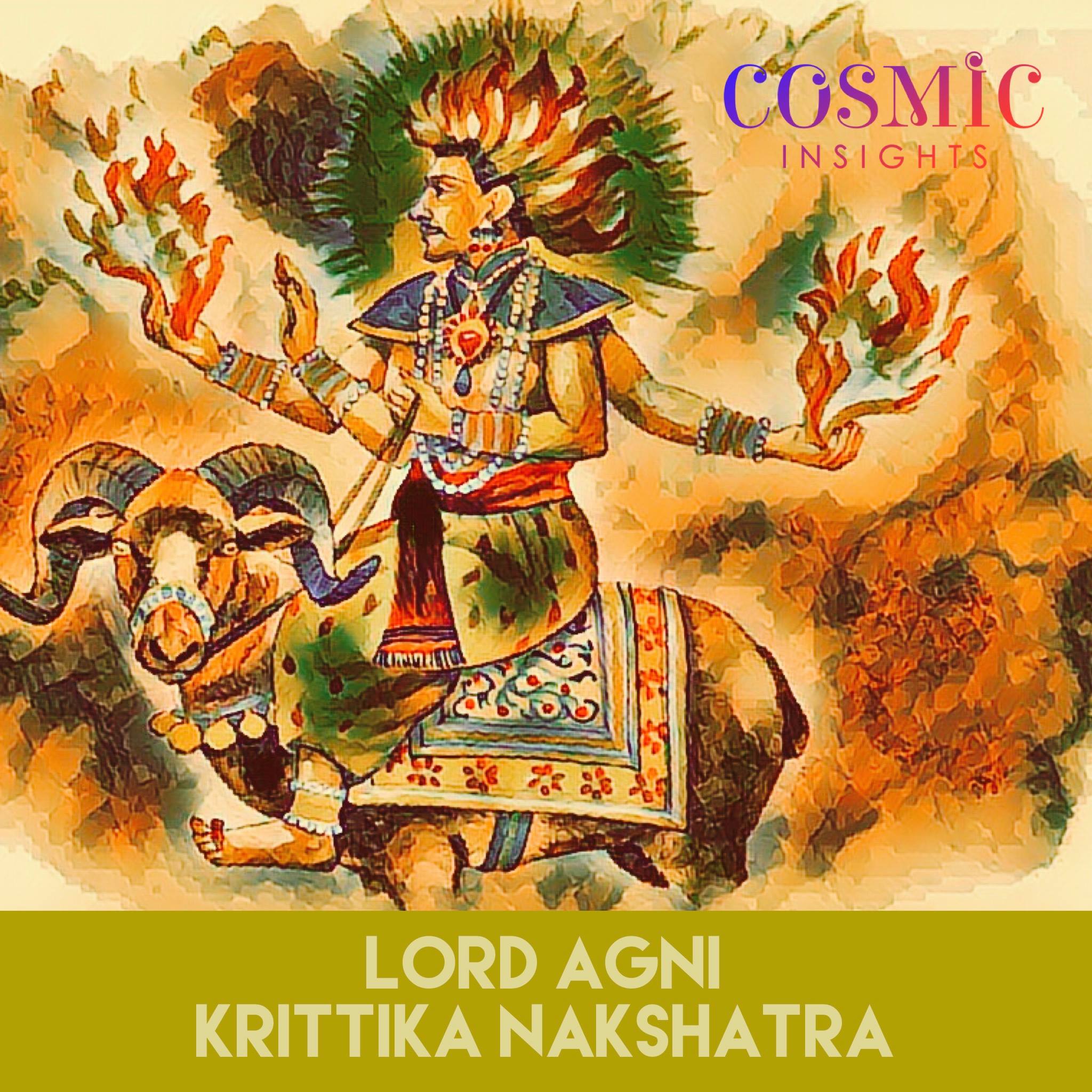
The many-sided symbolism of the ruling deity, Agni, is extremely complex. Physiologically he is first of all connected with the digestive fire, which ensures the digestion and assimilation of food. Consequently, Krittika rules appetite, cooking, digestion and similar things. Agni also symbolises the mental «fire» which allows information and knowledge to be digested and assimilated. Just as fire flares up and goes out, in Krittika people there is observed a tendency to experience frequent ups and downs in their life. If the Moon or the lagna fall into Krittika, then ambitiousness, arrogance and inner driving motives are often present in the native's personality.
Physiology and diseases: the thighs and the lower back, the crown and the back of the head.
Professions, people and places of habitation: inventors, discoverers, diggers. Heads of state or of other large structures. Military men, policemen, firefighters, those engaged in fire ceremonies. Barbers, tailors, butchers. Producers of weapons and explosives. Makers of sharp household objects and kitchen implements. All who work with fire, potters and blacksmiths. Producers of trading equipment and its users. Carpenters and building contractors. Skilful magicians, metaphysicians and astronomers.
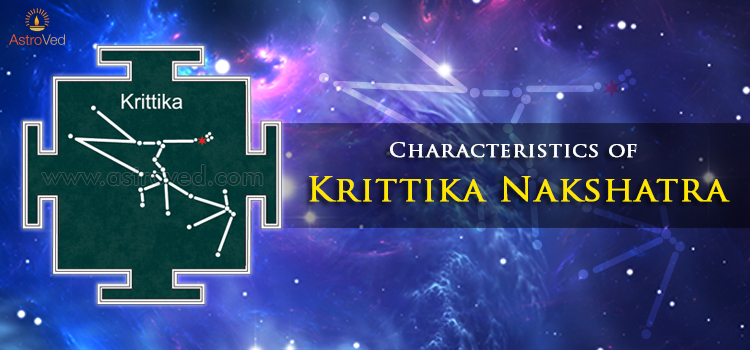
«Krittika is stout and red-faced. She has the head of a goat, yellowish-brown eyes, hair and eyebrows. She wears golden ornaments and rides upon a goat, holding in her hands a rosary and a spear» («Chaturvarga-chintamani» of Hemadri).
Krittika (Skt.: कृत्तिका) is represented in the sky by six bright stars in the open star cluster of the Pleiades. «Krittika» in translation means «axe», and the name of the nakshatra is also translated as «the cutting one». The Greek name of this star is Alcyone. Krittika is a star of demonic nature, but possessing forces of a mixed character. Another name for this star is Kartika, after the name of Kartikeya, the son of Lord Shiva. Kartikeya is the commander of the celestial army of the gods. The star is under the patronage of Agni, the god of fire. Birth under this star gives physical and creative forces, ardour, fervour, and also energy for the attainment of greatness.
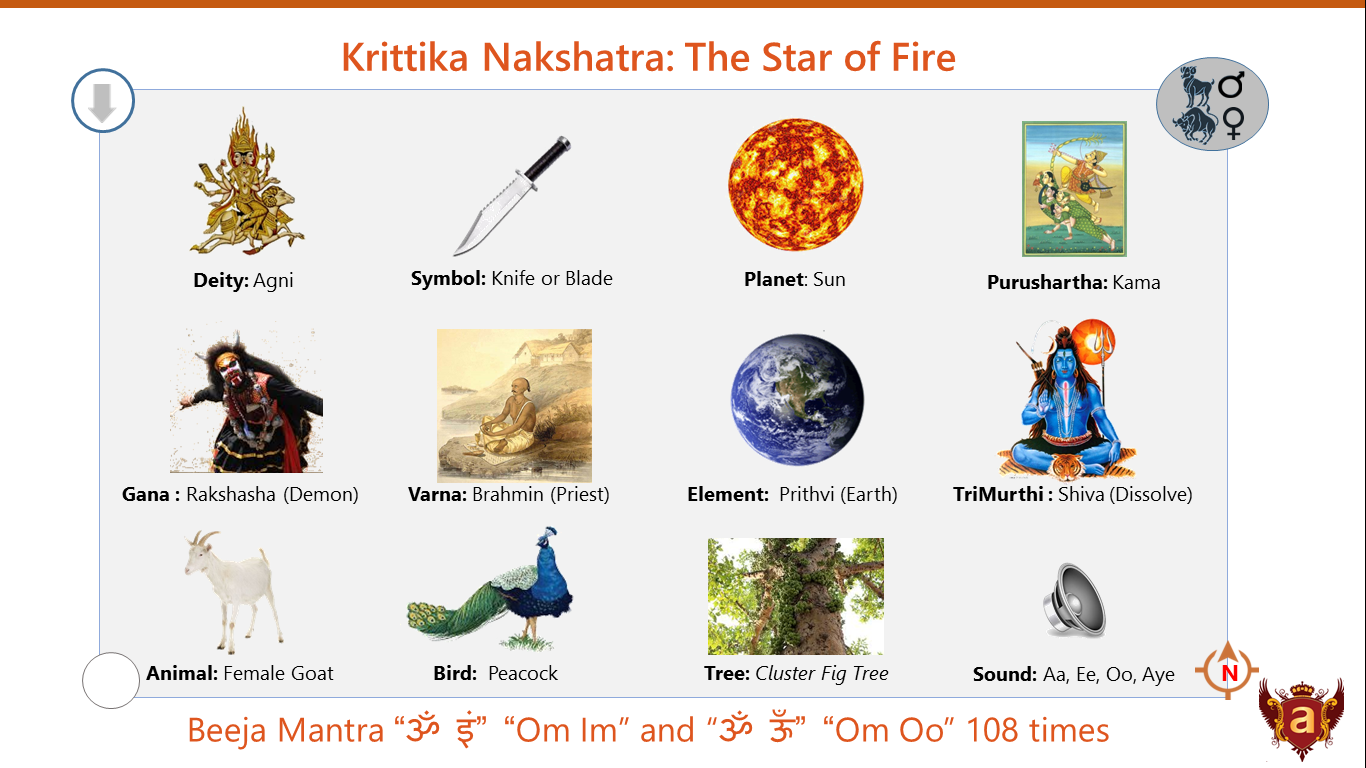
Characteristics of the nakshatra Krittika
Zodiac: 26°40′ of Aries — 10°00′ of Taurus
Deity: Karttikeya, Agni (the god of fire)
Origin: demonic
Ruling planet: the Sun
Goal: kama
Gender: female
Animal: the sheep
Element: earth
Direction: east, south-east, south
Varna/caste: brahmins
Guna: rajas
Quality: mobility
Temper: gentle, formidable (mridu-tikshna)
Ayurvedic constitution: Kapha
Body parts: the thighs, the lower back, the crown of the head
Symbol: a blade, a razor, an axe, a knife-blade, a knife, any cutting instrument, a flame, a peacock
Sounds: a, i, u, e
Enemy: Vishakha
The key concept of the nakshatra Krittika
A sharp mind, energy, a magnificent body, ambition, creativity.
Krittika possesses both constructive and destructive potential. The first is manifested through the actualisation of the need for creativity. The second — in counteracting tendencies which slow down the evolutionary process. Krittika strives to understand the cause of any action and situation and, consequently, often encounters a discrepancy between the apparent and the real, and imperfections of various kinds. And imperfection Krittika does not tolerate, since it sees in it an obstacle on the way to attaining the goal.
Planets placed in Krittika give a single-directedness of efforts, and act in a sudden and explosive manner.
Krittika personalities have a proud temper, are truthful, and bear themselves with great dignity. They are ambitious, strive for power, and dislike beating about the bush. They are distinguished by abrupt behaviour and tactlessness, on account of which they often offend or frighten those around them. However it should be remembered that Krittika natives go beyond the bounds of propriety not constantly, but only when they are excited. They are hot-tempered, but their anger lasts only a few seconds. Krittika illustrates the anger of the Sun rather than the anger of Mars.
Behind their outward cruelty and severity Krittika natives conceal a desire and an ability to care for and support others. Thus fire, despite all its destructive might, helps us to cook food and warms us on a cold day. Ultimately, fire makes life itself possible, since we all depend on the warmth (fire) of the Sun. Being the ruler of Krittika, it makes people born under this nakshatra a «life-support element» in their surroundings. The connection with fire indicates the creative potential of Krittika, which in turn means a strong connection with the Moon. It thus personifies the channel through which the energy of the Sun can be transmitted. A person with the Moon in Krittika becomes well known and possesses an attractive appearance. They are energetic in achieving a goal, but their mind is unstable.
On the spiritual level this nakshatra gives an awareness of something, the possibility of undergoing a deep purification. Towards the disclosure of its inner nature Krittika is called to move by the most direct path, and therefore all inner and outer obstacles on this path will be mercilessly destroyed. Krittika assists the development in a person of Divine qualities. In its rays demonic forces, manifesting in the form of false humility, egoism and so on, simply cannot exist. As a rule, the influence of this nakshatra brings about radical changes in a person's life. They become a «pillar of fire» and a focus of spiritual forces.
Krittika is the nakshatra of priests, but not in the literal, direct sense; rather it will indicate a spiritual, pure person. This nakshatra is connected with the God of fire — Agni, and therefore the nature both of fire and of people with this nakshatra is to remove everything unnecessary quickly and to establish cleanliness around them. Among the traits of character a strong stubbornness may manifest. Also a strong attachment to the mother. These people need to pay special attention to their diet. There may be problems with the father. There is a gift for the arts.
If Krittika is in the 1st house, then pride, ambition, a love of truth may manifest.
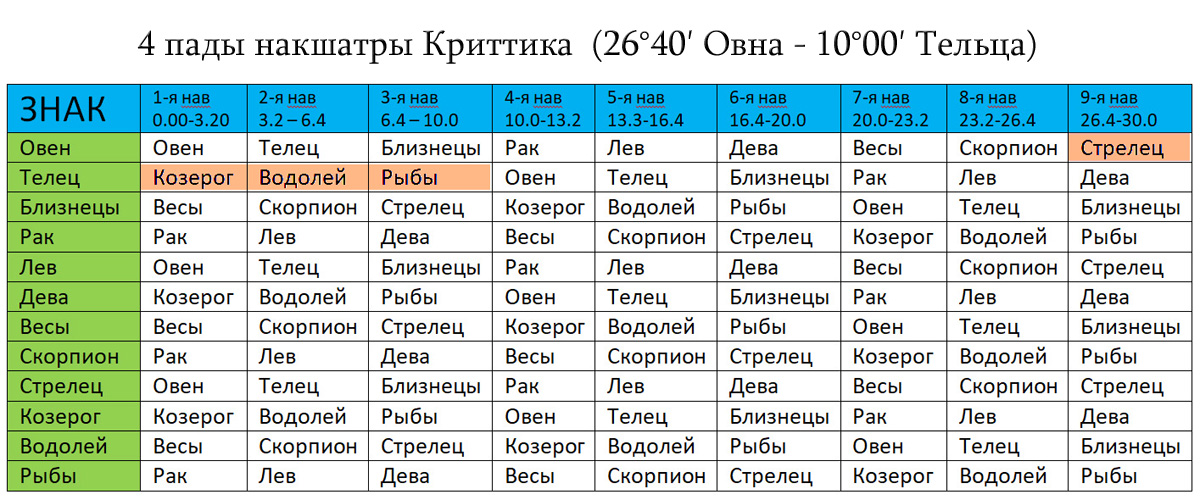
The padas (quarters) of the nakshatra Krittika
The 1st pada of the nakshatra Krittika (26° 40′ — 30° 00′ of Aries) falls into the navamsha of Sagittarius, ruled by Jupiter. It gives good manners, a talent for research, sickliness, a long life. Planets here bestow endurance and an iron will. Strongest are the Sun, Mars, Jupiter and Ketu.
The 2nd pada of the nakshatra Krittika (00° 00′ — 3° 20′ of Taurus) falls into the navamsha of Capricorn, ruled by Saturn. It generates a world-view that is materialistic rather than spiritual, and prompts a person to care for others — the Moon in this pada reaches the point of maximum exaltation. Mars and Saturn are strong here too, and Mars is connected rather with receiving support and nourishment than with providing them. If Saturn aspects the Moon, then an early death of the mother is probable.
The 3rd pada of the nakshatra Krittika(3° 20′ — 6° 40′ of Taurus) falls into the navamsha of Aquarius, ruled by Saturn. It gives intelligence, pride, valour, hot-temperedness and, possibly, poverty. This pada assists all kinds of learning. Not one of the planets is debilitated in Aquarius, and therefore, being in the third quarter, they can all show themselves well in the areas under their control.
The 4th pada of the nakshatra Krittika (6° 40′ — 10° 00′ of Taurus) falls into the navamsha of Pisces, ruled by Jupiter. It assists group work, the obtaining of a good education and philosophical knowledge. It indulges haughtiness. It generates anxiety, and as a consequence — poverty and sickliness. Jupiter, Venus and Ketu can use all the energy of this pada, whereas Mercury — only a certain part of it.
The ruling planet the Sun — the chief ruler of Krittika — gives it much energy, independence, strength, shrewdness, pride, ambition and self-motivation.
One part of the nakshatra (the first pada) is in Aries and is ruled by Mars. The union of the energies of two warlike planets makes it rather severe. The other part is placed in Taurus and experiences the influence of Venus. The Sun and Venus are natural enemies, and thus the second half of Krittika has a relation rather to the reconciliation of Apollo and Dionysus than to senseless military actions. The Sun influences Krittika more strongly than Venus, and therefore the Moon — the queen in the hierarchy of the planets — receives exaltation here. Venus is often characterised as an éminence grise or a minister of the queen (the Moon), which makes the relations of the Sun (the king) and Venus difficult to understand. In any case both these planets transmit to Krittika their creative potential and striving for knowledge, and moreover Venus also shares love, care and harmony, making the nakshatra more balanced.
If in the horoscope the Sun is conjoined with or exchanges houses with Mars or Venus, then energies analogous to the energy of Krittika arise. In this nakshatra the Sun, Mars and Venus are strong, but, as always, much depends on which pada they are in.
Professions of the nakshatra Krittika
A critic. A military man. A policeman. A firefighter. A manager. A technical specialist, inventors. Discoverers. A teacher, a university employee. A lawyer, a judge. A surgeon. An armourer, a blacksmith. Professions connected with the rehabilitation of drug addicts. A worker in an organisation taking part in the promotion of methods of self-improvement, of increasing self-confidence. A hairdresser, a tailor, an embroiderer. A prospector, a miner. A spiritual teacher propagating the necessity of deep purification, conducting fire rituals or worshipping Surya. Musicians, dancers, singers, fashion designers, models.
Places connected with Krittika
Places with a hot climate, deserts and arid lands. Agricultural lands, ranches for horned cattle, meadows. Tropical forests. Volcanic zones. Military bases and testing grounds. Government buildings, universities. Rehabilitation centres, orphanages. Factories and plants using fire in one form or another. Fireplaces, stoves, heating appliances inside the home. All places connected with the professions mentioned in the previous section.
Favourable activity under the nakshatra Krittika
Worship of fire. The conducting of a rite of purification. The renunciation of old habits. The prompt making of changes; A sudden completion. Actions requiring initiative, courage, the qualities of a leader and organiser. Military actions, disputes. The preparation of food. Sewing and embroidery. Shaving. All actions connected with the use of fire or heat, with care and upbringing, with honesty and sincerity. The beginning of study. Playing percussion instruments.
Unfavourable activity under the nakshatra Krittika
Communication. Diplomatic actions. Rest and relaxation. Activity on water. Any beginnings.
Illnesses connected with Krittika
Problems in the area of the neck and with the throat, fevers, malaria, headaches.
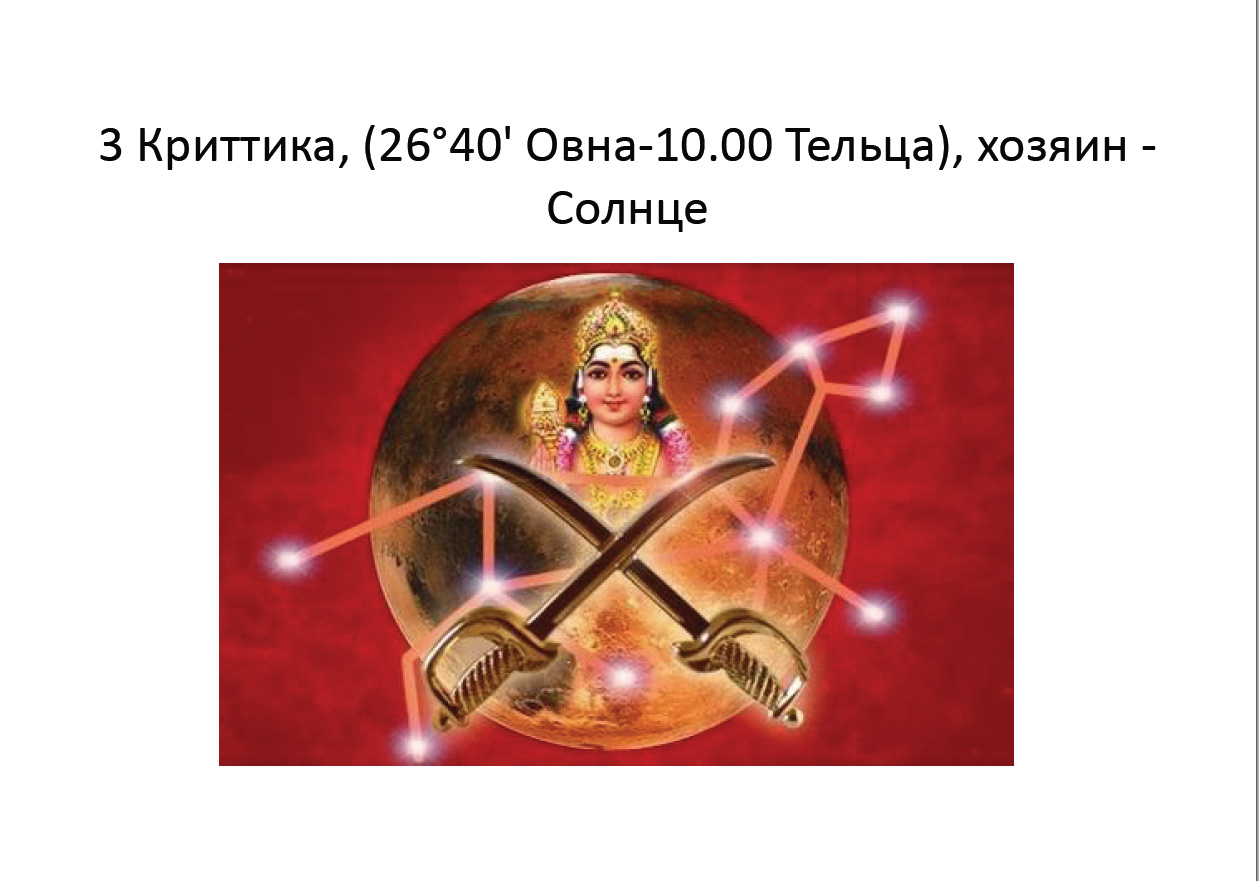
THE THIRD STAR— KRITTIKA 26° 40’ OF ARIES — 10° 00’ OF TAURUS
«Krittika» in translation means «axe». It consists of six stars. The Greek name of this star is Alcyone. Krittika is a star of demonic nature, but possessing forces of a mixed character. Another name for this star is Kartika, after the name of Kartikeya, the son of Lord Shiva. Kartikeya is the commander of the celestial army of the gods. The star is under the patronage of Agni, the god of fire. Birth under this star gives physical and creative forces, ardour, fervour, and also energy for the attainment of greatness.
GENERAL CHARACTERISTICS OF PEOPLE BORN UNDER THE INFLUENCE OF KRITTIKA
Men
A handsome appearance, well-developed musculature. They are reasonable, can give good advice, but themselves prefer to act under the influence of an impulse. They are very independent and freedom-loving, and avoid obligations. They cannot occupy themselves with one and the same thing for long; they quickly flare up and go out. They are optimistic, orthodox, energetic. It is hard for them to control their feelings, and they can be coarse and abrupt. As a rule, they do not live in their place of birth. Because of their vividly expressed qualities of a leader, partnership in work does not work out well.
Family life is usually happy. The wife is a good housekeeper, devoted, faithful, but possibly sickly. Therefore they often live separately. It should also be noted that men born under Krittika have a strong attachment to their mother.
In life there are many trials and changes. From 25 to 35 years and from 50 to 56 — good, fortunate periods in life.
They do not take care of their health. There may be tuberculosis, inflammation of the brain, meningitis, diseases of the trachea. Accidents and car crashes are possible.
Women
They are beautiful until 27 years, then their beauty quickly fades. Birth under this star gives a woman haughtiness, an inclination to quarrels, extreme independence.
They can achieve success in business. As a rule, they have a secondary education, but if they were born on 11 or 12 April (depending on the year) (the 27th degree of Aries) or 22 — 24 April (8 -10° of Taurus), then renown and a good education are possible. In family life not everything works out well.
Loneliness, childlessness, divorce are possible. If she has not married early, then at 37 years she may marry very successfully. She has cold relations with relatives. If in the horoscope there is an opposition of Mars and Jupiter, then infertility or the death of a child is possible. If Mars is in the twenty-sixth or in the twenty-seventh nakshatra, counting from the janma-nakshatra (the nakshatra of the Moon), widowhood is possible. Health is weak because of stress, overwork or an absence of inner peace.
If a woman having a vividly expressed star Krittika is born on a Saturday, then great misfortunes await her in life. The evil influence is destroyed if a benefic planet is placed between 28° of Virgo and 5° of Libra.
A Lagna in Krittika will be dynamic, creative and at the same time practical. How the personality of Krittika will develop depends on the strength of the ruler of the Lagna, Mars or Venus, and of the ruler of the nakshatra — the Sun. Any weakening or negative placement of these planets may increase the weakening of Agni and Krittika.
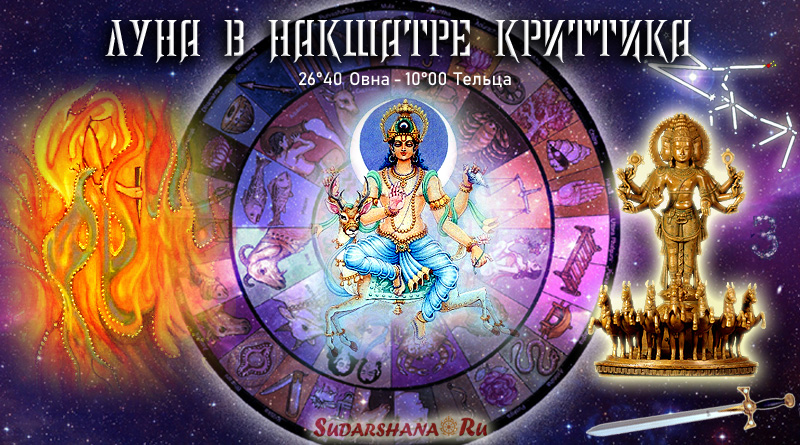
The Moon in Krittika
The Moon in Krittika gives healers or warriors, since they are not afraid to meet their demons or to fight with the causes of a problem. They can move away from the negative by means of right thinking. Krittika gives healing through intensive purification by fire. Control of the mind is quite strong here, since the Moon is exalted in Krittika, and at the same time such people must be careful with their destructive inclinations. The first Dasha of the Sun confronts the Moon in Krittika both with its weaknesses and with its strength from the earliest age. This gives them a sense of self-identification and of purpose in life, which substantially helps later on.
If the Moon is placed in Krittika and aspected by:
- the Sun — wealth, success in agriculture;
- Mars — sexuality, an attracting, magnetic personality. Diseases connected with immoderate sexual relations are possible;
- Mercury — prudence, kindness, responsiveness;
- Venus — a love of ornaments, of beautiful things;
- Saturn — diseases of the mother. If the Moon is placed in the second part of Krittika, then an early death of the mother is possible.
The Moon in the 1st quarter of Krittika, 26° 40’ — 30° 00’ of Aries
Good manners, sickliness, but a long life; problems with the opposite sex.
The Moon in the 2nd quarter of Krittika, 0° 00’ — 3° 20’ of Taurus
Atheism, an inclination to immoral deeds. If Saturn aspects the Moon an early death of the mother.
The Moon in the 3rd quarter of Krittika, 3° 20′- 6° 40′ of Taurus
Intelligence, pride, hot-temperedness. Poverty. If Rahu or Mars aspect the Moon in a woman's horoscope, then at the age of 30 she may become a widow.
The Moon in the 4th quarter of Krittika, 6° 40′ — 10° 00’ of Taurus
Poverty, illnesses. Education, knowledge of philosophy, haughtiness.
Well-known personalities with the Moon in Krittika: Bill Clinton, Ronald Reagan, Mick Jagger, Daniil Andreyev, Vasily Zhukovsky, Maxim Gorky, Innokenty Smoktunovsky, Nikolai Miklukho-Maklai, Ivan Michurin, Alexander Suvorov, Mikhail Kutuzov
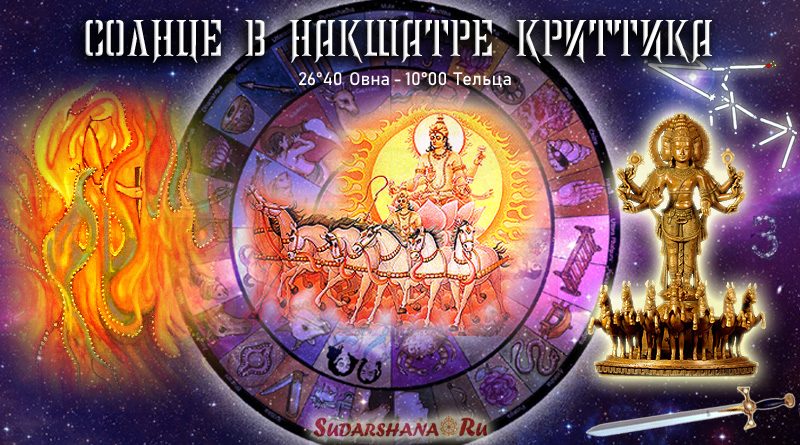
The Sun in Krittika
The Sun in this nakshatra will give enormous boldness and confidence. Krittika possesses the ability to create mighty people who are not afraid to meet difficulties face to face. It is important to remember that Krittika personifies the qualities necessary for struggling with difficulties and putting an end to confrontation. It is warming, harsh and supportive. Such people know how to use power wisely.
If the Sun is placed in Krittika and aspected by:
- Mars — thanks to activity, renown and wealth are attained;
- Mercury — musical abilities, an attractive appearance, a happy life;
- Jupiter — ambitions in politics, wealth;
- Venus — a beautiful appearance;
- Saturn — weak health, poverty, conflicts in the family.
The Sun in the 1st quarter of Krittika, 26° 40′ — 30° 00′ of Aries (birth from 13 to 16 May)
An interest in astrology. Accidents with fire are possible. If the Sun is in conjunction with benefic planets — many children. There may be eye diseases.
The Sun in the 2nd quarter of Krittika, 0° 00’ — 3° 20′ of Taurus (birth from 17 to 21 May)
A long life, happiness from children, wealth in the second half of life. A very developed intellect, a love of music. An abnormal development of the glands is possible, sometimes leading to cancer.
The Sun in the 3rd quarter of Krittika, 3° 20′ — 6° 40′ of Taurus (birth from 21 to 23 May)
A poor material position, wanderings, sickliness. If in a female horoscope the Sun is aspected by the Moon, then the woman may earn money by prostitution and suffer from venereal diseases.
The Sun in the 4th quarter of Krittika, 6° 40’ — 10° 00’ of Taurus (birth from 23 to 26 May)
Weak health, a low social position. Cruelty, irresponsibility.
The Sun in Krittika: M. Bulgakov, Nicholas the Second, A. Sakharov,
O. Berggolts, A. Conan Doyle, Y. Shevchuk.
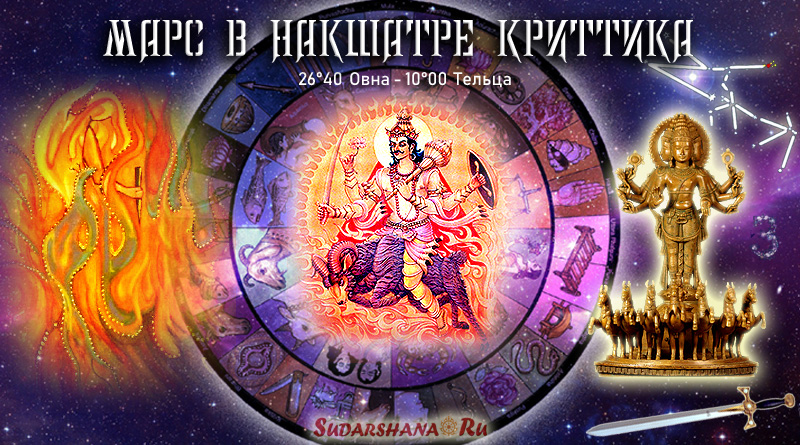
Mars in Krittika
Mars in the nakshatra Krittika gives calm, dedicated, extremely intellectual people. They are born warriors. Their instincts are directed towards defence, but they can remain calm in times of crisis. They can also fly into a rage, and therefore it is important for them to control themselves. They do not always like to confront anything, but if they are placed in such a situation, then they will accept the challenge and will not hide.
If Mars is placed in Krittika and aspected by:
- the Sun — the owner of the horoscope will have a very greedy wife, and they will never be able to satisfy her desires;
- the Moon — hostile relations with the mother, many wives;
- Mercury — the owner of the horoscope will be taciturn, pleasant in association, religious, inclined to art and rich;
- Jupiter — love for the members of their family, an inclination to music and art, wealth comes after 30 years;
- Venus — a high post in the army or in the production of weapons;
- Saturn — wealth, health, the respect of other people.
Mars in the 1st quarter of Krittika, 26° 40’ — 30° 00’ of Aries
The owner of the horoscope has an imposing appearance, and is able to argue their speech well. They may become a well-known lawyer, an army or police officer, or be connected with the government. If Mars is placed between 28° and 29° 40’ — the owner of the horoscope will make great efforts to attain a high position and will achieve it. The best results in life will manifest during the dasha of the Sun, the sub-period of Mars, and in the dasha of Mars, the sub-period of the Sun, and also every time Mars or the Sun passes through this quarter. Many extramarital relations should be noted, income from business connected with stainless steel or explosives, and the danger of accidental poisoning, as a result of which death or paralysis of some part of the body may come. Head injuries, meningitis and acute inflammatory diseases are possible.
Mars in the 2nd quarter of Krittika, 0° 00’ — 3° 20’ of Taurus
A person whose Mars occupies this position will be sociable, hospitable, but vindictive. A head injury, inflammation of the larynx or a cataract on the eye are possible. An aspect to Mars from a benefic planet will not give the birth of a son. The owner of the horoscope will be able to earn well as an engineer or through the production of military materials.
Mars in the 3rd quarter of Krittika, 3° 20’ — 6° 40’ of Taurus
A good education, knowledge of various religious scriptures, inherited property, the possession of jewels, profit from the government, a quiet profession, an ability to argue their speech. The owner of the horoscope will have a repellent appearance and will make money through speculation.
Mars in the 4th quarter of Krittika, 6° 40’ — 10° 00’ of Taurus
Weak health and an imbalance of the kapha-dosha. The owner of the horoscope will have obedient and virtuous children, good earnings from the sale of medicines or explosives. Success will come to them after concluding a marriage. If there is an aspect from a benefic planet — two marriages.
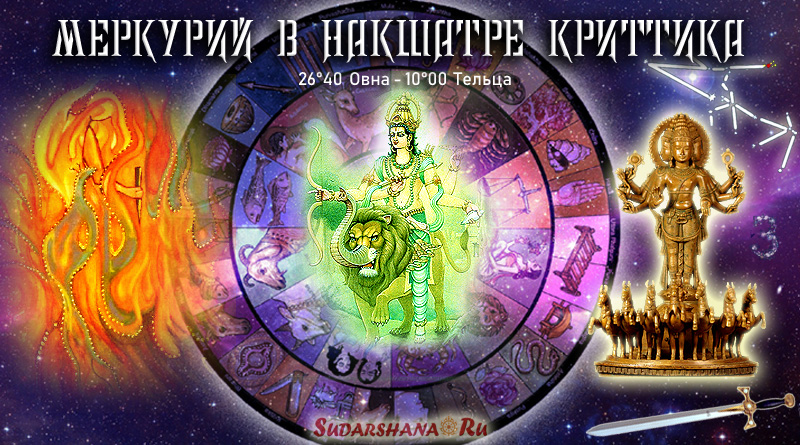
Mercury in Krittika
People with Mercury in Krittika attract attention not only because of their bright appearance, but also thanks to their intellect and mind.
If Mercury is placed in Krittika and aspected by:
- the Sun — sickliness, poverty, responsiveness and a striving to help others;
- the Moon — wealth, persistent labour and fame;
- Mars — sickliness, rejection by the family, punishment from the government;
- Jupiter — excellent qualities of character, the head of a city;
- Venus — heightened sexual potency, power over the opposite sex, good fortune;
- Saturn — poverty, unhappiness from the members of the family.
Mercury in the 1st quarter of Krittika, 26° 40’ — 30° 00’ of Aries
An average length of life, a lean build. The owner of the horoscope will work in the government or engage in business receiving large government subsidies. They will enjoy the respect and love of the masses. They may also become a musician, an actor or a writer. A hedonist. A conjunction of the Sun with Mercury placed in this quarter says that the person will become a good doctor or surgeon.
Mercury in the 2nd quarter of Krittika, 0° 00’ — 3° 20’ of Taurus
A sturdy build, a cheerful and sociable temper, wealth, happiness, longevity. More than one marriage is possible. After 40 years the owner of the horoscope may renounce worldly life. A conjunction with Jupiter speaks of occult abilities.
Mercury in the 3rd quarter of Krittika, 3° 20’ — 6° 40’ of Taurus
A beautiful appearance, strength, practicality. If Mercury, placed in this quarter, is conjoined with Saturn, great intellectual achievements are to be expected.
Mercury in the 4th quarter of Krittika, 6° 40’ — 10° 00’ of Taurus
The owner of the horoscope is devoted to their work and will attain a high professional position. They will have many sons. They will live to 62 years, and will have weak health. A conjunction or aspect of Jupiter will make them a consultant on financial questions.
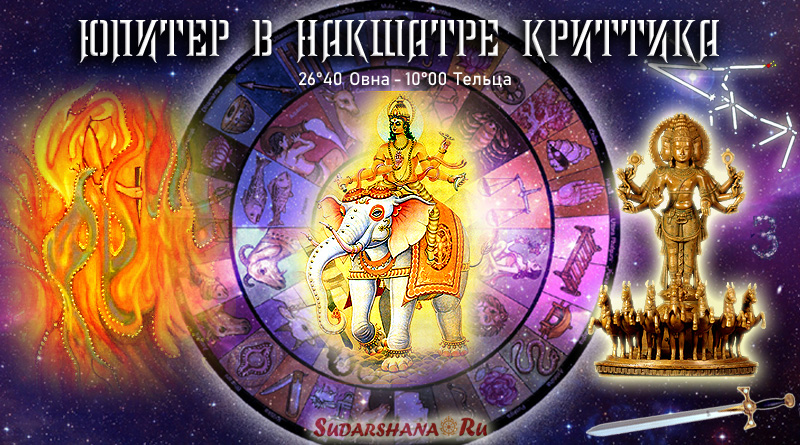
Jupiter in Krittika
Jupiter in the 1st quarter of Krittika, 26° 40’ — 30° 00’ of Aries
Intellect, a broad outlook, a good reputation, an inheritance, fame, much travel, an interest in history and literature.
Jupiter in the 2nd quarter of Krittika, 0° 00’ — 3° 20′ of Taurus
Attachment to the mother, renown, a passion for young girls.
Jupiter in the 3rd quarter of Krittika, 3° 20’ — 6° 40’ of Taurus
The owner of the horoscope has attractive qualities of character, is demanding of themselves, and those around them love them. They may become an adviser in the government, but this will not bring them much money.
Jupiter in the 4th quarter of Krittika, 6° 40’ — 10° 00’ of Taurus
A good education, an inheritance, honesty in the conduct of affairs. Marriage takes place at about 27 years, when Jupiter makes a cyclical transit through the nakshatra Ardra. The marriage partner earns a lot of money.
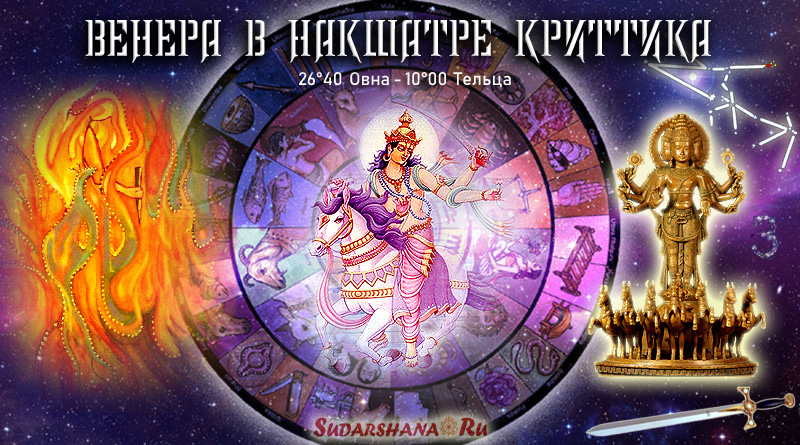
Venus in Krittika
Venus in the nakshatra Krittika can give a large number of admirers. A media personality of a kind — a person of show business. Two personalities may coexist in them — a light-hearted joker on the one hand and a puritan on the other. Among such people there may be both priests and compères.
If Venus is placed in Krittika and aspected by:
- the Sun — wealth. The possession of vehicles;
- the Moon — an inclination to sexual excesses, honeyed speech;
- Mars — an absence of comfort in life, illegal activity;
- Mercury — boldness, good qualities of character;
- Jupiter — wealth, happiness from wife, children and relatives;
- Saturn — weak health, poverty and the destruction of the reputation.
Venus in the 1st quarter, 26° 40’ — 30° 00’ of Aries
The owner of the horoscope — a man — will have an effeminate appearance, and a woman — the opposite. Conflicts in marriage, an inheritance and nyctalopia (night blindness) are possible. If there is an aspect of the Sun, an early marriage is to be expected. The Moon aspecting Venus in this quarter, in a female horoscope, gives the birth of many children, but only some of them will survive. The aspect of Mercury leads to a lack of understanding with brothers and sisters.
Venus in the 2nd quarter, 0° 00’ — 3° 20’ of Taurus
Work connected with the sea or service in the navy. If in a female horoscope the Moon aspects Venus — a disturbance of the menstrual cycles, the birth of children, many of whom will die.
Venus in the 3rd quarter, 3° 20’ — 6° 40’ of Taurus
Nobility, possibly two marriages. Suitable professions: teacher, musician, actor or business connected with cosmetics.
Venus in the 4th quarter, 6° 40’ — 10° 00’ of Taurus
An unexpected inheritance, the receipt of good income through theatre or music.
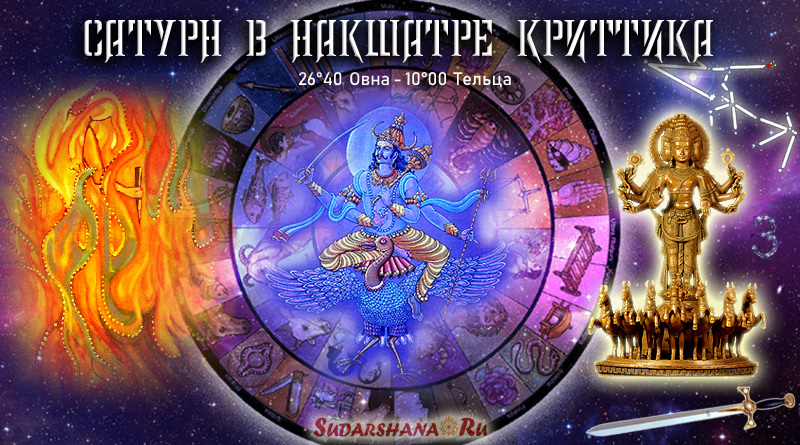
Saturn in Krittika
Saturn in the nakshatra Krittika gives such people an understanding that the fire within them can be destructive if it is left uncontrolled, and therefore from the very beginning they learn to tame it. They may become keen on yoga and other similar disciplines.
If Saturn is placed in Krittika and aspected by:
- the Sun — a good orator, tactful and peace-loving;
- the Moon — the acquisition of wealth during their life, the receipt of blessings from the government;
- Mars — happiness;
- Mercury — poverty, bad company;
- Jupiter — the respect and love of those around them, charity;
- Venus — closeness to the higher strata of society.
Saturn in the 1st quarter of Krittika, 26° 40’ — 30° 00’ of Aries
A weak body, bad teeth, problems connected with the digestive system and the liver. The owner of the horoscope will live a long life, will hate their father, will experience problems in childhood, but in mature age will become happy. They will be lazy, unrestrained, ambitious, jealous and cruel.
Saturn in the 2nd quarter of Krittika, 0° 00’ — 3° 20’ of Taurus
The owner of the horoscope will marry a woman much older than themselves, will be unhappy in marriage and dissatisfied with their life.
Saturn in the 3rd quarter of Krittika, 3° 20’ — 6° 40’ of Taurus
Earnings connected with the products of agriculture. If in a female horoscope the Sun aspects Saturn in this quarter, there will be no marriage or it will lead to unhappiness.
Saturn in the 4th quarter of Krittika, 6° 40’ — 10° 00’ of Taurus
If the Moon in a female horoscope aspects Saturn in this quarter — an unattractive appearance, poor health and a weak character. The aspect of the Moon in a male horoscope, on the contrary, will bring wealth, strength and success through women.
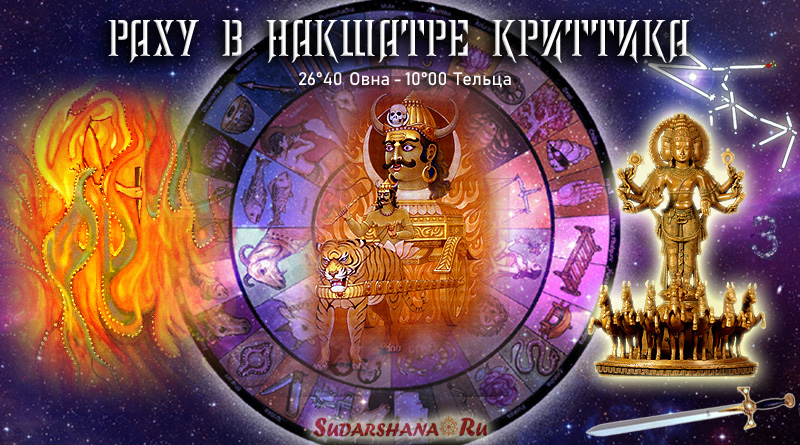
Rahu in Krittika
Rahu can stir up the fire of Krittika and allow it to go beyond the bounds of reason in the manifestation of desires and sensuality. It is easier for the Krittika of Taurus to cope with this, whereas Aries can give a sudden energy impulse which may swallow up the person.
Rahu in the 1st quarter of Krittika, 26° 40’ — 30° 00’ of Aries
A sturdy build, good health, great sensuality, extramarital relations. The owner of the horoscope will have a black mole on the face. They will love their father very much, and will receive patronage.
Rahu in the 2nd quarter of Krittika, 0° 00’ — 3° 20’ of Taurus
A person having Rahu in this position will be inclined to spiritual development. More than one marriage awaits them, and sufferings connected with the loss of children and wealth. They will earn their means of living in foreign countries.
Rahu in the 3rd quarter of Krittika, 3° 20’ — 6° 40’ of Taurus
Problems with speech are possible. The owner of the horoscope will be extremely lazy and will experience extreme poverty. They will earn their means of subsistence by petty trade. A person whose Rahu occupies the 3rd quarter of Krittika will have reddish eyes.
Rahu in the 4th quarter of Krittika, 6°40’ — 10° of Taurus
An absence of inclination to family life, a striving for renunciation. Even if the owner of the horoscope marries, they will perform their duties very badly. They will earn enormous wealth from 20 to 35 years, but will spend it all on charitable purposes or on the building and maintenance of temples.
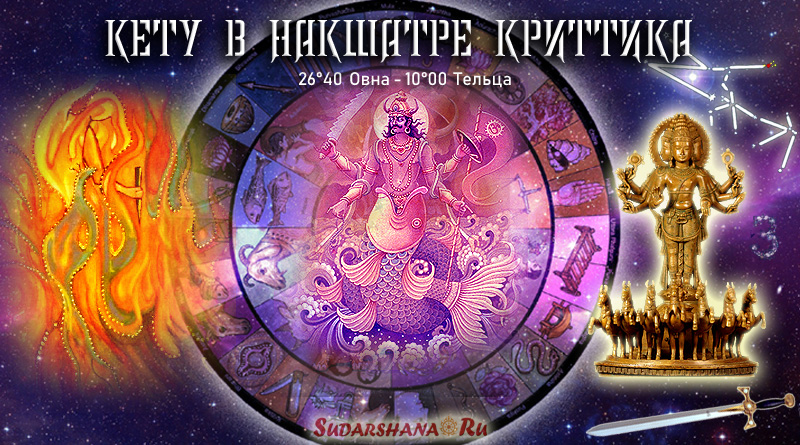
Ketu in Krittika
Ketu feels problematic with all the fire of Krittika; it will create a heap of problems for the person which they will have to cope with, and at the same time the «headless» Ketu cannot always suggest ways of solving them. Such people need to develop intuition and to redirect this force into a positive and more spiritually directed channel, or else to use this energy for burning up residual karma. Problems begin when not all the karma is ready to be destroyed; only the ripened part of it can be annihilated. Ketu cannot always know how to distinguish this, since it is debilitated in the Krittika of Taurus.
Ketu in the 1st quarter of Krittika, 26° 40’ — 30° 00’ of Aries
If there is no benefic aspect, then the length of life of the owner of the horoscope will be 50 years. They may become a metallurgical engineer or a chemist. In the professional field they will encounter a multitude of difficulties and obstacles. Their attempts to correct the state of affairs will not lead to success. Heart diseases are possible.
Ketu in the 2nd quarter of Krittika, 0° 00’ — 3°20’ of Taurus
Life far from close and dear people, an absence of wealth, weak health, a great attachment to women and wine.
Ketu in the 3rd quarter of Krittika, 3° 20’ — 6°40’ of Taurus
The owner of the horoscope will suffer enormous losses on the stock exchange, will be censured by the government and will support the interests of people of a low class. In case of need they will receive timely help. Family relations will be problematic, since their wife will bear a female child not by them.
Ketu in the 4th quarter of Krittika, 6°40’ — 10° 00’ of Taurus
A person whose Rahu occupies this position in the horoscope can expect a comfortable and luxurious life, obstacles in their career, frequent confrontation with superiors and problems in marriage or a very late marriage.
based on the material of the books «Vedic Astrology of Matrimony» (Indubala)
and of the site «Encyclopaedia of Vedic Science»

* * * * * * * * *
The nakshatra Krittika (26° 40′ of Aries — 10° 00′ of Taurus)
General indications: The symbol of Krittika is a sharp, razor-like instrument, and its deity is Agni, the sacred fire. Mythologically, Krittika (the Pleiades) are the foster mothers of Karttikeya, one of the sons of Shiva. Krittika people are by nature abrupt, caustic and shrewd. The razor symbolism also speaks of sharp or honed instruments and of the work performed with their help, for example the preparation of animal skins for leather and fur goods. Sharp objects — pens and quills for writing, sewing needles, and also sharp instruments such as drills — are all ruled by Krittika. The weighty office of Karttikeya — commander-in-chief of the celestial army — says directly that Krittika has power over war, battles, armies and disputes, and the fact that Karttikeya is famed for monumental heroic deeds implies that his nakshatra too is always in view and that aspirations and projects going beyond the bounds of the ordinary are inherent in it. Since the body of Karttikeya and his armour shine like the Sun, Krittika also rules gold and is in a certain way connected with wealth. The mythological plots connected with it tell, among other things, of adoption, foster motherhood and of the responsibility laid upon one to give patronage to others. The many-sided symbolism of the ruling deity, Agni, is extremely complex.
Physiologically he is first of all connected with the digestive fire, which ensures the digestion and assimilation of food. Consequently, Krittika rules appetite, cooking, digestion and similar things. Agni also symbolises the mental «fire» which allows information and knowledge to be digested and assimilated. Just as fire flares up and goes out, in Krittika people there is observed a tendency to experience in their life frequent ups and downs.
If the Moon or the lagna fall into Krittika, then in the native's personality ambitiousness, arrogance and inner driving motives are often present.
Physiology and diseases: the thighs and the lower back, the crown and the back of the head.
Professions, people and places of habitation: inventors, discoverers, diggers. Heads of state or of other large structures. Military men, policemen, firefighters. Those engaged in fire ceremonies. Barbers, butchers, tailors. Producers of weapons and explosives. Makers of sharp household objects and kitchen implements. All who work with fire, potters and blacksmiths. Producers of trading equipment and its users. Carpenters and building contractors. Skilful magicians, metaphysicians and astronomers.
Robert Svoboda
Kartikeya or Kartika is the god of war, he is connected with the planet Mars. And the third star in order in the horoscope, Krittika, is located partly in the constellation of Aries and partly in Taurus.
Of the whole extent of the star, 13 degrees 20 minutes: 3 degrees are in Aries and the remaining 10 degrees are in Taurus. And the nature of people born under one and the same star, but in different parts of it, in different signs, will of course be coloured by one astrological sign or another.
The Sun is the ruling planet of this nakshatra.
So, the astronomical location of this nakshatra is in the constellation of the Pleiades. There is such a constellation. Those who have been interested not only in astrology but also in astronomy have surely heard this name. And in ancient Indian mythology, in Vedic mythology these stars, these Pleiades, are regarded as the wives of the great sages.
And in Western astronomy, traditional astronomy, these wives, or these stars, are called Alcyone, Celaeno, Electra, Taygeta, Maia and Asterope. And Alcyone is considered the most beautiful, the brightest of all the stars of this group. And these stars are located in the upper part of the constellation of Taurus, that is, of that bull visually perceived in the sky, the body of the bull – this is the upper part of its torso, one might say.
The Moon is exalted at 3 degrees of Taurus, precisely in this constellation. It is precisely in this constellation that the Moon is at its strongest. The favourite constellation of the Moon, according to history, mythology, according to astrological knowledge, is the next star in order, of which we shall speak later — this is Rohini, but the point of exaltation, of its exaltation, the Moon reaches precisely in the constellation of Krittika. In that half of it which belongs to the sign of Taurus.
Krittika represents the nature of a person who is very resolute, very persistent, enduring and strives for the attainment of greatness. These are very often people who are fighters for some social achievements, for public achievements, social reforms, or spiritual warriors, spiritual fighters.
The ruling deity of this constellation is Agni. Agni — well, the Russian root already betrays the nature, for those who perhaps did not know this before, that this is the God of fire and transformation. Now it is very important that we, as it were, perceive the God of fire, but the meaning of the energy of fire, although we encounter it every day, somehow escapes us. That is why we do not remember it.
The most important thing is transformation, the ability to be transformed.
This is very important. For a person who is or was born under the influence of this star it is very important to understand the meaning of this. Because people often come with a question about what their calling in life is, what their occupation is. They expect that we will name for them specific professions, categories, levels and so on. Or offices in which one can work, yes? But the most important thing, notwithstanding that we try to help, to direct the person as precisely as possible, but the most important thing is that the person should understand the main driving energy of their nature, which is revealed thanks to knowledge about the star under which the person was born.
So, as I have already said, the ruling deity of this constellation is fire, Agni — the deity of fire. So, the most important thing that we need to find out to begin with is what the main ruling energy is. Because, if you understand what the main energy is that constitutes the essence of your nature, then you will be able to find both a way of spiritual advancement forward, of service, if the person is engaged in spiritual practice, and a way of occupying oneself in social activity, that is, of turning out to be useful to other people and so on.
So, the main energy of the star Krittika is dahana shakti. Shakti — you know, the term means energy. Dahana-shakti means that which cuts off or that which destroys everything negative, that which purifies. But this is akin to the fact that, if a person has some inflammation on the body or an abscess — this is something that has to be, or must be, cut out or destroyed in order for the body to function in a healthy way, and so that the person does not suffer from it.
To cut off, to destroy the negative in order to reach the depths of truth. That is, that which prevents a person from understanding truth, that which prevents a person from becoming aware of themselves. Krittika (literally one more meaning of the word Krittika) — is to cut, or the cutting one; it is also called the star of fire since it is ruled by fire and Agni — the god of fire is the deity of the sacred fire, of the sacrificial fire. That is, of the fire which always serves the purification of any activity.
In the Vedic tradition practically no serious activity was begun without a fire sacrifice. There was no sense whatever in beginning a new activity if you had not purified yourself of former imprints. The main function of the Vedic ritual, the fire ritual, — is to erase former imprints and to lay down new ones, those which are more valuable to the person. That is, to carry out such a reorganisation of the person's system of values, of their deep consciousness. It was precisely this function that fire performed.
If you are familiar with the now historic technique, a thing of the past, or, let us say, the technology of recording on the magnetic tape of a tape recorder, then in a tape recorder there are always two magnetic heads. One magnetic head lays down the sound, and since the magnetic tape was often used for repeated recording, there was also a need to erase the recording which had been there before.
And for this there was installed beforehand, in front of the recording magnetic head, a so-called erasing head. It had no particular mystical functions. It was simply a pure magnet, an electromagnet, which by the force of its magnetic field removed from the tape all the signal that had been on it before. And this made it possible, as it were, to renew the tape and to record on it a completely new recording of new quality.
Now approximately such a function is played by the energy of fire in the universe. That is, when people are going to progress, this means that they must renounce former values which are imprinted, impressed very deeply in their consciousness.
In order to lay down new material, to enter into a system of new values, a person needed to erase what prevented them from moving forward. And it was precisely this function, precisely this purpose, that the fire sacrifice served, that fire served. And the meaning of fire above all in Vedic civilisation came down to this.
Even the preparation of food on fire in Vedic culture is always equated to a sacrifice, to a sacred act. Therefore, Vedic etiquette — the etiquette of common sense, let us say — presupposes that a person who has visited (I apologise for the non-broadcast term) the toilet, has emptied their bowels, must take a full bath. Because in a defiled state a person must on no account approach fire, cook on it, since this is a transformation, a transmutation of food, which will influence consciousness. Therefore the person had to be absolutely clean.
Therefore there were quite strict prohibitions precisely because the energy of fire is no joke, not only in the sense of danger, burns, accidents and fires, but precisely because fire — is that which begins to transform our consciousness. If we ourselves are in a defiled state, then by the force of fire we can imprint, impress these defilements still more deeply into the depths of our consciousness. This is why this is a very important star.
True, there are no less important or more important ones among the 27, but just so that you understand the meaning.
So, dahana shakti. A shakti which gives a person the possibility of purifying, not only of purifying their own consciousness, but also of helping other people to get rid of what prevents them from progressing spiritually, what hinders them by virtue of coming into conflict with the person's new values, towards which they strive.
Therefore the star Kartika or Krittika is connected with that force which helps a person to overcome a certain inertia of former habits, of a former system of values which is no longer of any value, and gives the person the possibility of progressing.
This is precisely why the star, since it is ruled by the god of fire — Agni, is very favourable for the conducting of fire sacrifices.
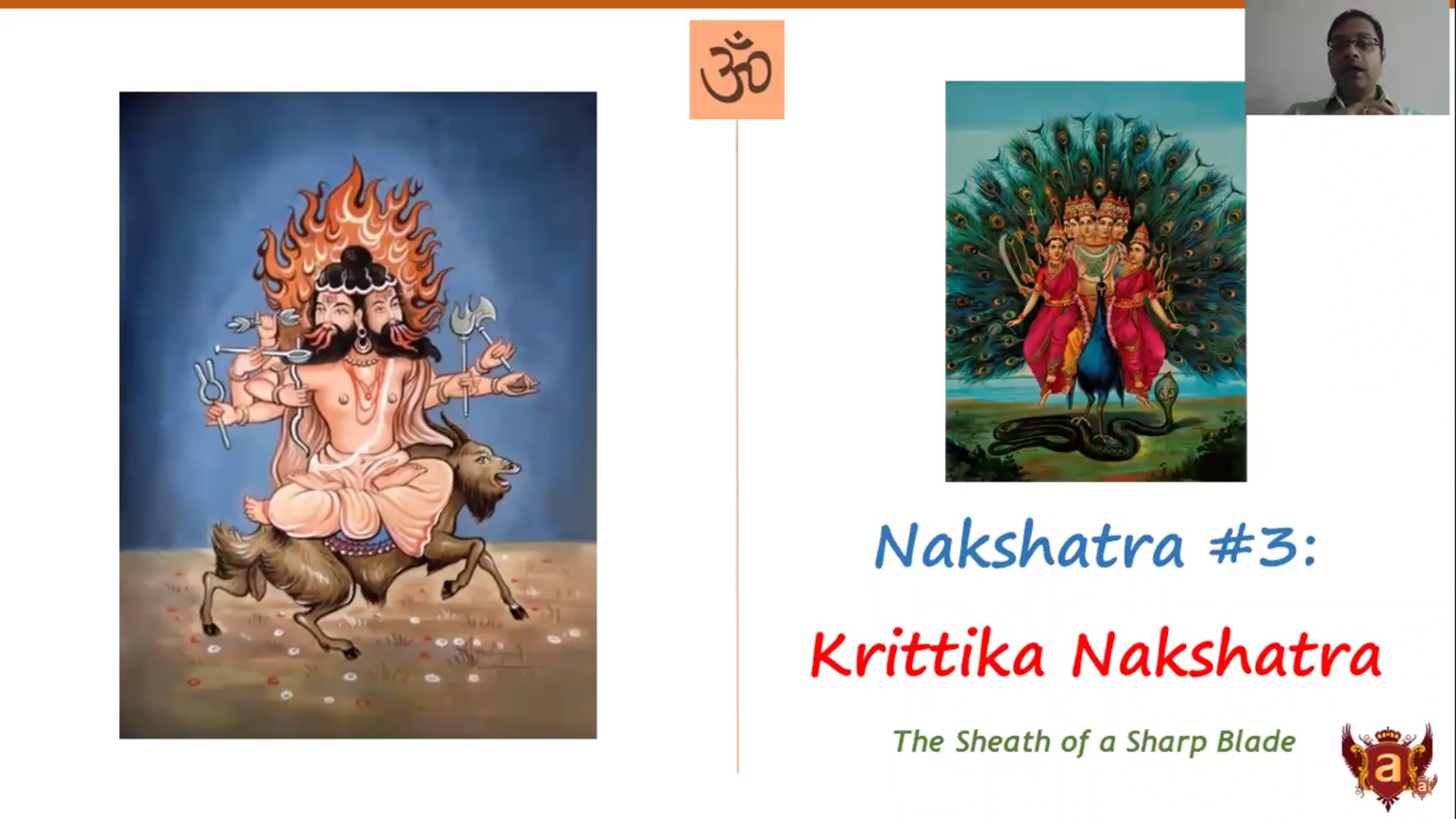
So, this star is able to evoke in a person their divine qualities through situations which influence their consciousness like a fire of purification. That is through a certain catharsis, through a certain crisis, which is also connected with fire. Any crisis, a psychological crisis, a health crisis in a person, for example a high temperature – is a certain crisis, but this crisis exists not merely so that the person should suffer and be unable to fall asleep at night or should be thirsty. This crisis is needed so that the person can be purified of the illness and rather of the toxins which have accumulated in excess in their body, and can feel as if newly born.
Krittika belongs to the category of stars of mixed order. Which means that this star is favourable for some everyday, daily, systematic activity of that kind, chiefly and including such as preparation, cooking.
The star Krittika besides reflects a burning desire for radical changes in personal and public life. Chiefly of course this effect of transformation, the effect of such an impulse, of a striving for changes, for purification, is inherent in the star, in that part of this star which falls in the sign of Aries. Because Aries in itself is a sign ruled by Mars. That is, as it were it turns out that the star is ruled by the god of fire Agni and part of this star is in the territory of the sign Aries, ruled by Mars. Therefore this is a very vivid, let us say, a very fiery manifestation.
And consequently two people born under this star may differ in the manifestations of some manifestations of their nature precisely by this criterion, by the quantity of fieriness. Since the remaining 10 degrees of the star Kartika fall into the constellation of Taurus, or are located, placed in that sector of the constellation Taurus, which (the constellation, I mean) is in its turn ruled by the planet Venus.
So, since this part of the star Krittika is ruled by Venus, these people are distinguished by well-known gifts in the fine arts and this may be produced or generated by the combination of the influence of Venus and the Sun. Since the Sun is the ruling planet of the constellation.
That is, it turns out that the star itself is under the rulership of the planet the Sun, it is connected with this energy, it carries this energy within it. At the same time it may occupy part of a sign ruled by Mars or part of another sign, Taurus, ruled by Venus. Hence the various combinations of the influences of the planets.
A great many people who have been engaged in the sphere of art, artists, musicians, dancers, singers, people from the fashion business, clothing designers, were born under this star. And beauty, elegance, luxury are also inherent in the mood of this star and, as astrologers studying the biography of Princess Diana say, they say that in this well-known personality Venus was located precisely in this star. Venus also manifests itself very broadly, powerfully manifests itself, when it turns out to be in its own sign, in this star.
The shadow side of the star Krittika is stubbornness and aggressiveness. It would be strange if these qualities were not a side effect.
So I must disappoint those who have the Moon, the Sun or the rising sign in these signs — certain qualities of obstinacy really are inherent in them. Aries natives by virtue of the fact that this is a fiery and aspiring sign, a sign of aspirations, a sign of unshakeable resoluteness. Taurus natives — because this is an earthy sign.
But the shadow side, as I have already said, of this star is a certain stubbornness and aggressiveness. The nature of the character, and also well-known destructive tendencies and problems with anger may also be observed. That is, in people of this type it is sometimes possible to restrain anger for some time, but the mechanism of accumulation operates and then at some moment their patience comes to an end, and they release all the anger accumulated over a long period. All at once, and moreover not always successfully, not always, as they say, at the right address.
Fiery qualities, manifestations of fiery emotions, such a fighting nature may be the result of this influence. Also, a person may have well-known problems with regard to the control of their diet and eating habits.
And, as something positive perhaps, this cannot be counted among the shortcomings, this is a kind of manifestation of a well-known childlikeness, not infantilism, but such a spontaneity in the nature of a person born under this star.
For people born under this nakshatra the main task in life for them is discipline, the control of a person's desires and the ability to find for themselves such kinds of activity which on the one hand would be pleasant, and on the other hand would restore vital energy and would have such a general health-giving effect both on the psyche and on the body of the person.
That is, to renounce the need for comfort is quite difficult for these people. And it can hardly be said that this would be justified, because a certain nature is inherent in each of us. And what for one person is as it were simple, they accept it with pleasure, and it leaves no negative trace on their psyche, for people of another type, similar to people born under the influence of the sign Taurus or in this case the star Krittika, for them excessive control, excessive asceticism, excessive restriction of their feelings may not be justified. And they must simply find a balance in not burying themselves in such utter excess, in an utter excess of comfort, of idle pastime.
The deity, as I have already said, of this star is the god of fire – Agni. The qualities which are inherent in these people are a brilliant appearance. They are, as a rule, noticeable and well known. They have a quite calm nature, and are very good advisers.
These people act very well and successfully in the sphere of consulting, in the sphere of psychological training (what it is now customary in the West to call «coaching») and they are very good as consultants, experts in various questions in firms, state institutions and so on.
These people are quite purposeful, they are resolute, they are reasonable. Now here is the pleasant truth. But they are sometimes unstable in their mind. That is, the mind, because of its enormous force, not because such a restlessness on the principle of «wherever the wind blows, there go I» is inherent in it, but because very powerful energies influence the mind of people who have the Moon in this star.
It is somewhat harder for a woman with herself, if she was born under this star. Since the influence of this star gives a certain haughtiness, an inclination to quarrels and an enormous urge for independence. At the same time it gives a woman the possibility of achieving success in business, in male territories.
Renown is possible, a good education is possible. However, in family life everything works out not as smoothly as one would wish. Loneliness, childlessness and divorce are possible. The standard text mentions that these women marry either very early, or at 37 years. That is, those who have not married need not despair, they may marry successfully.
They have quite cold relations with relatives and an extremely undesirable position in the horoscope is that of Mars and Jupiter in the chart of such a woman, that is, the opposition of these two planets, since this may lead to an absence of children.
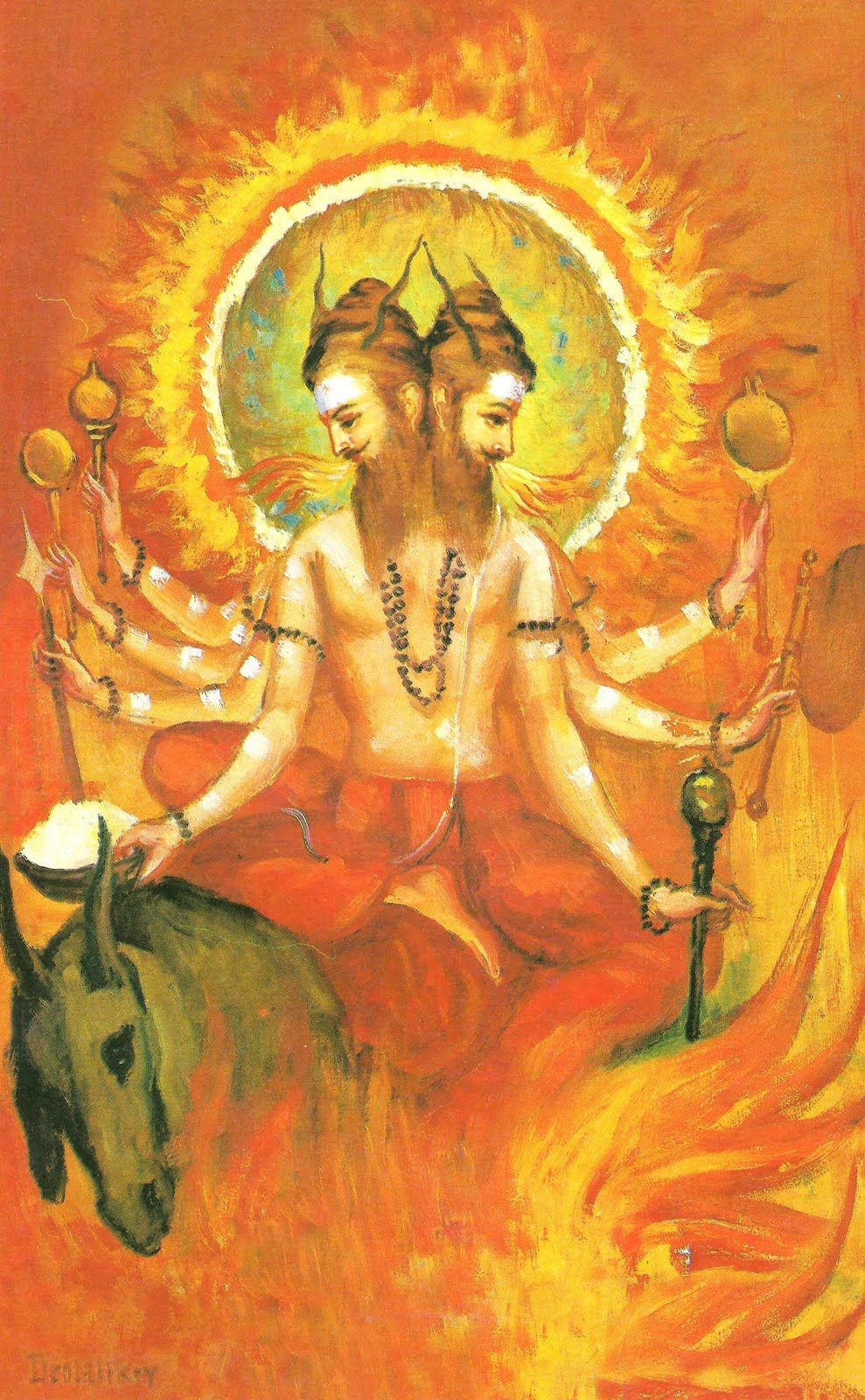
AGNI («fire»)
In Vedic and Hindu mythology the god of fire, of the domestic hearth, of the sacrificial fire. By the number of mentions in the «Rigveda» he occupies second place after Indra (about 200 hymns).
Agni is the chief of the earthly gods, the personification of the sacred fire, and stands at the centre of the principal ancient Indian ritual. The basic function of Agni is mediation between people and the gods (Agni is the divine priest): the sacrificial fire raises the offering to heaven with the tongues of its flame.
Agni has a multitude of hypostases: fire in the sky (the sun, lightning), fire in the waters, the fire of the sacrificial pyre; he is both old and young.
The versions of Agni's origin are also numerous: he was born in the waters, arose in the sky, was born of himself, came from the friction of two pieces of wood, understood as an act of conception; his parents are heaven and earth. Agni is the son of Daksha, of Dakshina, of Ila, of Prishni, of the priest, of the sacrificer, of the morning rays, of plants and so on.
He is one (a god) and many (the sacrificial fires); the threefold nature of Agni is spoken of: he was born in three places: in the sky, among people and in the waters; he has three dwellings, he has a threefold light, three lives, three heads, three powers, three tongues).
Agni is friendly to people, to duty, unites spouses, brings wealth, encourages singers, smites enemies, darkness. The names of Agni are numerous, although the highest of them is kept secret: he is an asura, the devourer of the offering, the first Angiras, Mitra, Rudra, Matarishvan, Bharata and so on; of his epithets especially well known are: Jatavedas — «knower of all beings» [or «knowing about (preceding) births»], Tanunapat — «son of himself», Vaishvanara — «belonging to all people», Narashansa — «praise of people».
The connections of Agni with the gods are very varied. In the texts Agni appears together with the adityas, Indra, the maruts, Yama, Soma and others, but these connections, as a rule, do not form a plot. The same can be said of the individual motifs in which Agni acts together with human characters.
Of the individual plots and motifs with the participation of Agni several may be noted: he hides in the waters, is dismembered and distributed («Brihaddevata»), for comparison: the Vedic motif of the disappearance of Agni and his hiding in the waters; Agni hides in the waters and curses the fish, the frogs; Agni seduces the wives of the sages and gives birth to the god of war Skanda; Agni turns into a dove, and Indra into a falcon; obeying Brihaspati, Agni turns into a woman and sets off in search of the frightened Indra; the sage Bhrigu curses Agni for having betrayed to the demon Puloman the name of his wife Puloma (I); Agni heals Indra (V); Agni is sent by Indra to King Marutta (XIV); Agni as the leader of the vasus (for example, in the war with Ravana, «Ramayana»); in the creation of the goddess Kali Agni gives her eyes, a spear («Markandeya-purana»); Agni is the son of Angiras (the puranas), but Angiras is the adopted son of Agni («Mahabharata» III); Agni is the husband of Svaha, the personified ritual exclamation, and others.
These plots and motifs are insufficiently distinct. In them Agni usually appears as a dependent character (a messenger, a mediator, an accompanying person). The cult of deified fire in the form in which it is attested in the vedas goes back to the period of Indo-Iranian unity (for comparison: the «Avesta»). Then again, the name Agni itself reveals reliable Indo-European parallels, for comparison: Slavonic ogn, Lithuanian ugnis, Latin ignis and others. Traces of Agni are perhaps preserved in the name of the deity Akni in the 2nd millennium BC in Asia Minor.
Ruslan Narushevich, V.Y.Toporov
General remarks concerning the nakshatra Krittika
Those who are born in this nakshatra are not recommended to have any relations with people born in Mrigashira, Mula, Ashlesha and Purva Phalguni. People whose Moon is placed in Krittika are born in the period of the Sun, then follow the periods of the Moon, Mars, Rahu, Jupiter, Saturn, Mercury and so on.
In the night sky, Krittika is visible as a cluster of seven stars known as the Pleiades. In Vedic astrology, Krittika resides in the sign of Aries as well as Taurus. The name Krittika translates as, «one who cuts» and the symbol is a razor or sharp object. Thus, a critical nature with both creative and destructive tendencies is displayed by this star. Krittika is also represented by the element of fire as the presiding deity is Agni, the god of fire. Those born under this star are combative with a fiery disposition. The Sun is the ruling planet, which also signifies fire and at the highest level, purification. Krittika natives have an adventurous spirit and are constantly looking to fuel their fire with new information and experiences.Physical activity and an energetic demeanor are characteristic of those born under this nakshatra. Kartikeya (Muruga), who was raised by the seven wives (the stars of Pleiades) of the seven sages, is also associated with Krittika. There is a nurturing quality to this star, which is often hidden behind a tough exterior.Those born under this nakshatra are commonly involved with teaching or universities. They may have a sharp tongue and dislike imperfection, yet they have amazing will power, independence and the capacity to support others. This is a star of courage, awareness and purification.
General Characteristics: Determined to achieve greatness; tenacious will; sharp, cutting and penetrating by nature.
Translation: «The Cutter»
Symbol: Razor, Axe, or Flame
Animal Symbol: Female Sheep
Presiding deities: Agni, the God of Fire and Lord Muruga (Kartikeya)
Controlling Planet: Sun
Ruling Deity of Sun: Shiva
Nature: Rakshasa (Demon)
Mode: Active
Number: 3
Gender: Female
Dosha: Kapha
Guna: Rajas
Element: Earth
Disposition: Mixed (both sharp and soft)
Bird: Peacock
Tree:
Common Name: Fig
Botanical Name: Ficusracemosa
Seed Sounds: Ah, Ee, Oo, Ay (see Padas of Kriitika)
Also related to Planets: Mars, as ruler of the Aries; Venus, as the ruler of Taurus
Each Nakshatra is divided into four quarters called padas that contain more specific characteristics of a person born during the pada of Krittika:
Padas:
| First Pada | 26°40′ – 30°00′ of Aries Ruled by Jupiter Soul Sound: Ah Keyword: Exploratory |
| Second Pada | 00°00′ – 03°19′ of Taurus Ruled by Saturn Soul Sound: Ee Keyword: Material |
| Third Pada | 03°20′ – 06°39′ of Taurus Ruled by Saturn Soul Sound: Oo Keyword: Humanitarian |
| Fourth Pada | 06°40′ – 09°59′ of Taurus Ruled by Jupiter Soul Sound: Ay Keyword: Creative Manifestation |
Favorable: Famous within their group;respectable leader; attractive appearance;dignified; self-motivated; ambitious; confident; courageous;unshakable determination; goal oriented; materialistic; ability to acquire possessions; great pride in what they do; honors commitment; straight forward; peaceful nature; bright; strong appetite.
Unfavorable: Unstable mind; changeable; vacillating; stubborn; dissatisfied; impatient; responds too strongly to challenges; sets goals or expectations too high; overextends their health with constant activity; nervous; excitable; aggressive; passive-aggressive; difficulties with food and eating; gluttonous; motivated by desire; child-like nature.
Professions: Positions of authority or management, generals, critics, teachers, university occupations, lawyers, judges, technical professions, any field related to sharp objects such as knives or swords, fencing, archer, blacksmith, jeweler, surgeon, professions involving explosives or fire, fire fighter, police, military, miners, cooks, rehabilitation specialist, motivational trainer, ceramics, spiritual teacher, hair stylist, tailor, work in orphanages.
Famous Krittikas: Bill Clinton, Ronald Regan, Mick Jagger, Gregory Peck, Bob Dylan, Frida Kahlo
Favorable Activities: Starting new projects, activities requiring courage, initiative or honesty, military tactics, sudden changes, breaking old habits, activities requiring fire or heat, beginning education, debating, cooking, sewing, and favorable for many activities.
Unfavorable Activities: Diplomacy, social activities, relaxation, or activities involving water.
Sacred Energy Vortex: Kanjhanaaharam Sri GhatraSundareswarar
The temple which is most significant for Krittika star is located in the village of Kanjhanaaharam, near Mayiladuthurai in Tamil Nadu, India. This shrine is the most auspicious temple for those born under Krittika and they should visit this shrine to make offerings to Lord Shiva.
At this sacred vortex, Lord Shiva appears in the form of Sri Kathra Sundareswarar. The word Kathra translates as «to endure with eminent capability.» Lord Shiva was in a state of stillness while performing Kathra Jyoti Yoga. Goddess Parvati offered a golden tender coconut while performing penance which allowed Shiva to attain deep serenity. It was in this deep state of Kathra Jyoti Yoga that Shiva emerged as Sri Kathra Jyoti Peruman and Goddess Parvati arose from the gold tender coconut as Sri Tungabala Sthanambighai. Karthika Sundareswarar has the ability to produce six brilliant lights known as Karthigam light, through which Lord Muruga originated.
The Goddess, Sri Tungabla Sthanambighai, is personified at this sacred temple with the Keera Sathra parrot on her left should. This parrot chants the Vedas and the gives darshan known as Vedmirtha Keeran. It is auspicious for girls of a mature age to receive this darshan before entering marriage. In addition, water from the sacred river Tungabhatra should be used to perform an abhishekam for the Goddess. Those who visit this temple and make offerings can release the negative effects of evil eyes cast upon them as well as appease challenging eighth house planetary transits.
Those born under Krittika star should offer ghee lamps in earthen pots and silk clothes to the poor people at the temple. As the star Krittika gained its brightness at this shrine, offering prayers on the Krittika star day brings prosperity.
Krittika natives, your incense is made with the herb Fig as prescribed by the Vedas.