
Planets in the 7th house and married life

Depending on its degrees and on where it stands within the house, a planet in the seventh house will show different qualities — and the results will differ accordingly. Some planets act favourably, others create trouble. Let us look at what the various planets give in the 7th house, and under what conditions.


The Sun in the 7th house: a lack of respect
The placement of the Sun in the 7th house was not welcomed by the ancient sages. The person will marry late. The spouse may be pleasant in appearance and of good family, but will often be ill. In a man's chart this position says that he treats his wife without respect and even feels aversion towards her.

The Moon in the 7th house: a wife with a naive gaze
A person with the Moon in the 7th house may be called fortunate. He will take as his wife a sweet and charming, though inconstant, girl with a pale complexion and naive eyes. The beauty of the spouse will not, however, keep the husband's attention from other women. Mantreshwara, the author of «Phaladipika», shares this opinion too; he also says that the chosen one will be very beautiful and lucky, and that understanding and love will reign in the family.

Mars in the 7th house: obstacles on the road to happiness
Mars stirs up anger and destroys peace, which leads to losses. Remedial measures, however, can help in this situation. Under the influence of Mars the person loses patience quickly, often flies into a rage and cannot control himself, which tells badly on family life. The wife of such a person is said to be very brave.

Mercury in the 7th house: intellect and honour
The sages speak very well of Mercury in the 7th house. The spouse will be of good family. She has a sharp intellect, is hard-working and firm in her faith in customs and traditions, allows her husband to lead the family and carries out his will. She may, however, be excessively talkative. A person with this position in the chart will win fame, and his merits will be recognised by the state.

Jupiter in the 7th house: wisdom and good manners
An undamaged Jupiter gives good fortune, renown and material comfort. A person with a good Jupiter in the 7th house is marked by politeness, good manners, charisma and refined taste, and is respected. His father is proud of his capable son, whose achievements far surpass his own. The person looks at life optimistically and attains a good standing in society.
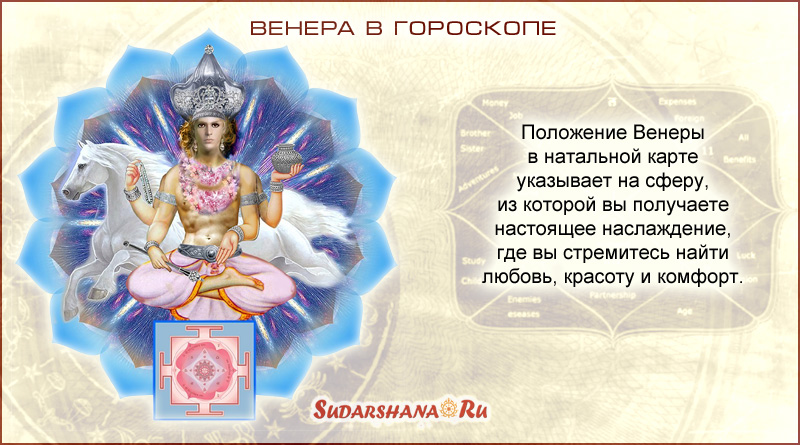
Venus in the 7th house: sensuality
Standing in the 7th house, Venus, the karaka of marriage, affects marital affairs directly. Astrologers noticed long ago that the position of a karaka in the house of its own significations gives results that are not quite the usual ones. Venus in the 7th house will therefore bring an element of the unusual and of disorder into the private life. Such a person's marriage will become a subject of gossip, and the wedding itself will be highly original. The spouse will be an incredible beauty and clever with it.

Saturn in the 7th house: the factor of delay
Saturn in the 7th house fills life with riddles. If it stands in its own sign or in exaltation, the marriage will not be a late one, but in all other cases there will be a very long wait. The partner will be the leader in the family. The person himself is marked by cleverness, cunning and selfishness, and forms liaisons with widows or divorced women. His chosen one will be thin, not very attractive, and possibly older in years or simply older in looks.

Rahu in the 7th house
Rahu in the 7th house tells badly on health and well-being. For almost all his life the person may suffer from diabetes or from venereal

Ketu in the 7th house
Ketu and Rahu are similar in nature. Ketu in the 7th house spoils family life, acting mainly through ill-wishers from outside. The couple
The general results of the planets in the 7th house are described above. Bear in mind that other factors — the rulership of houses, the sign in the 7th house, the nature of that sign and so on — may correct them substantially. The specific results we have found in practice will be discussed separately.
(Mridula and T. Prakash Trivedi)
