
Nakshatras
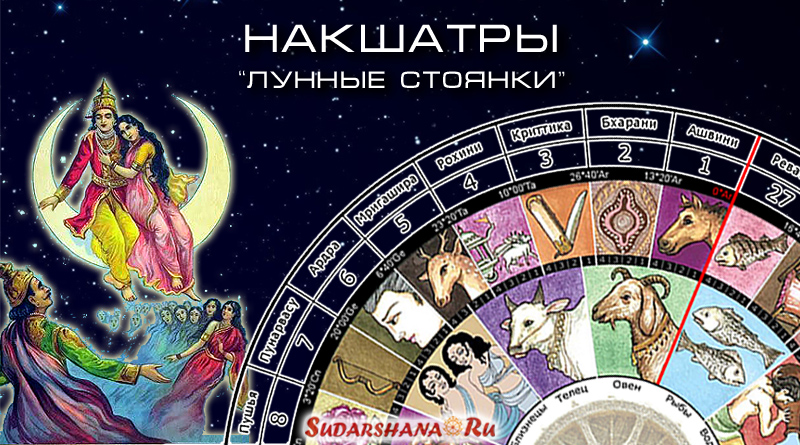
The nakshatras: the lunar mansions
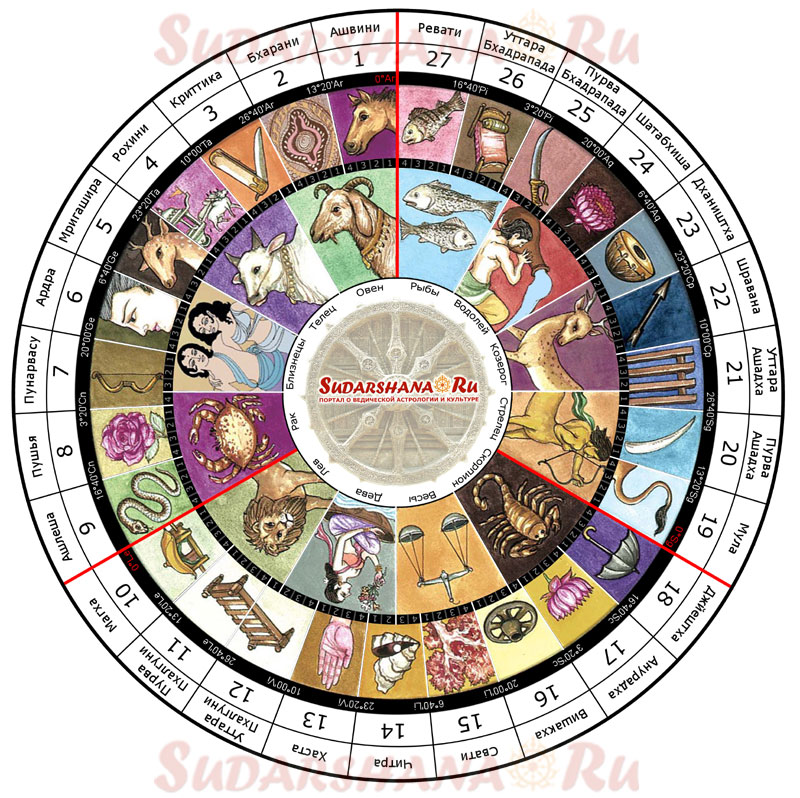
The nakshatras are narrower areas of the zodiacal belt, of 13°20′ each — unlike the signs, which occupy 30° each in the zodiac. They represent higher stellar civilisations, and also our «stellar great-great-grandmothers», each of which has its own unique character and nature. There are 27 nakshatras in all (the 28th nakshatra — Abhijit — lies a little to one side of the zodiacal belt).
| The ruling planet of the nakshatra |
1st cycle (paryaya) |
2nd cycle (paryaya) |
3rd cycle (paryaya) |
| Ketu | 1. Ashwini | 10. Magha | 19. Mula |
| Venus (Shukra) | 2. Bharani | 11. Purva Phalguni | 20. Purva Ashadha |
| The Sun (Surya) | 3. Krittika | 12. Uttara Phalguni | 21. Uttara Ashadha |
| The Moon (Chandra) | 4. Rohini | 13. Hasta | 22. Shravana |
| Mars (Mangala) | 5. Mrigashira | 14. Chitra | 23. Dhanishta |
| Rahu | 6. Ardra | 15. Swati | 24. Shatabhisha |
| Jupiter (Guru) | 7. Punarvasu | 16. Vishakha | 25. Purva Bhadrapada |
| Saturn (Shani) | 8. Pushya | 17. Anuradha | 26. Uttara Bhadrapada |
| Mercury (Buddha) | 9. Ashlesha | 18. Jyeshtha | 27. Revati |
THE ENERGIES, OR SHAKTIS, OF THE NAKSHATRAS
Every nakshatra carries within itself a particular energy, called shakti, connected with the power of the god who rules the nakshatra. Every shakti, like any energy, has a lower and an upper level of influence and an average, general meaning. The action of a shakti can be traced by observing plants, healing (the curative effect), religious views (the cult), marriages (marital relations) and death (the liberation of the soul from the body). This teaching takes its origin in the Vedas, such as the «Taittiriya Brahmana I.5.1.» and in the commentary of Bhattabhaskara Mishra.
The first part of the description of each nakshatra is the classical one, while the second consists of Professor Frawley’s comments on the classical meaning of each nakshatra (source — https://www.liveinternet.ru/users/anna_milano_mystery/post339365680 )
1. Ashwini (Ashwini)
Ashwini is ruled by the Ashwins — the twin horsemen. The nakshatra gives the ability to carry out swiftly what has been conceived (shidhra vyapani shakti). Its upper level of influence is the path to swift healing. The lower level of its influence is curative therapies. In the general case Ashwini frees the consciousness from illnesses. Ashwini gives the possibility of swiftly attaining a goal, and also impulses towards carrying out what has been conceived. The healing power of Ashwini is noted above; it manifests especially in the ability to give energy for carrying out what has been conceived: a swift, radical or miraculous cure, as well as rejuvenation and the giving of new strength. Ashwini characterises prana, or the vital force, which works swiftly in the way of stimulation, of rendering help and of moving to a new level of activity.
2. Bharani (Bharani)
Bharani is ruled by Yama (Yamaraja), the God of death. It gives the power to take things away (in the broad sense of the word) — apabharani shakti. The upper level of the nakshatra’s influence is responsible for the journey of the soul after leaving the body. The lower level of its influence is the spiritual connection with the abode of the forefathers (the kingdom of the dead, or the homeland). In the general sense Bharani grants new life in new incarnations. Bharani takes away that which has fulfilled its purpose in life, up to its new incarnation. This nakshatra illuminates all the movements of the soul outside the body. Yamaraja directs the soul and accompanies it in the astral world, where it can come to know its karma for the life to come and prepare for rebirth. Yamaraja personifies discipline and sacrifice.
3. Krittika (Krittika)
Krittika is ruled by Agni, the god of fire. This nakshatra gives the power to burn (dahana shakti). The upper level of its influence is heat, the lower is light. The meaning of Krittika is burning, or purification. Krittika burns away everything negative and purifies everything that is polluted (in the broad sense), destroying what is bad, and also prepares everything that is not yet ripe for that kind of rectification. Most often Agni is associated with the god of the sacred fire. Thus purification is most likely his prevailing act, one that brings no destruction. It may be said that through such purification what actually takes place is the sifting out of unnecessary (polluting) admixtures. Agni is, among other things, the fire that takes part in the preparation of food — which is another positive factor of its nourishing effect. The nature of fire is originally virginally pure.
4. Rohini (Rohini)
Rohini is ruled by Prajapati, the Creator. This is the power of growth (rohana shakti). The upper level of Rohini’s influence is the growth of plants, its lower level is the flow of water. The meaning of this nakshatra is creation. Rohini favours growth on absolutely every level, granting abundance very generously. Nevertheless, this nakshatra also awakens a certain degree of jealousy, since others may resent the fact that a person receives something for nothing, without the slightest effort on his part. Moreover, Rohini produces desires. But all this is secondary compared with its main meaning — prosperity. Prajapati is the Creator who bestows everything desired, and therefore with Rohini we must be very careful in our desires!
5. Mrigashira (Mrigashirsha)
Mrigashira is ruled by Soma — the god of the Moon, or of the nectar of immortality. The power of this nakshatra consists in the satisfaction of needs (prinana shakti). The upper meaning of the influence of the nakshatra Mrigashira is spreading, development and new knowledge; the lower influence corresponds to the pleasure of weaving (the production of clothing). Mrigashira characterises the world of pleasures, bringing those very pleasures into life. Mrigashira is connected with the joys of life. It is like beautiful clothing that makes our life more attractive. Soma characterises an immense enjoyment that has been attained, won, bought or stolen — in other words, its acquisition has not always come by easy paths. But, on the other hand, that to which no efforts have been applied does not always bring joy.
6. Ardra (Ardra)
Ardra is ruled by Rudra, the furious form of the lord Shiva, who represents thunder. Its power is therefore persistent effort, especially in relation to attaining the goals set in life. The upper level of this nakshatra’s influence is the hunt, or the search. Its lower level is the attainment of the goal itself. The general meaning of the nakshatra Ardra is the path found towards attaining what is desired. Ardra moves us to great efforts in life and to a struggle that may bring enormous benefit, but with an indispensable persistence in the wish to carry out what has been conceived. Rudra personifies the hunter and the «lord of the bow» in one. The main idea of this nakshatra thus implies the setting of a task (a goal) and its subsequent realisation. For what has been conceived to be carried out, it is important that the goal should be positive from the outset, carrying good within itself, and that there should be steadfastness in attaining it and the ability to «shoot» at the right moment. Rudra is, among other things, the lord of wild animals.
7. Punarvasu (Punarvasu)
Punarvasu is under the rulership of Aditi — the mother of the gods. The energy of this nakshatra consists in the ability to attain abundance, or stability (vasutva prapana shakti). The upper level of Punarvasu’s influence is wind, or air; the lower level is moisture, or rain. It is symbolised by the return of vital forces to plants and people. Punarvasu is responsible for the return of energy and for vitality; its influence may be compared with the return of the long-awaited rainy season after a period of drought. This nakshatra has the ability to give us a creative upsurge and inspires us to «self-renewal». Aditi is also called the goddess of the Earth; she gives us every possible blessing and gives life to all the existing deities.
8. Pushya (Pushya)
Pushya is ruled by Brihaspati, the god of Higher Wisdom. Its power therefore lies in the ability to open up divine (spiritual) energy (brahmavarchasa shakti). The upper level of this nakshatra’s influence is the cult of sacrifice. The lower level of Pushya’s influence is the priest offering sacrifice to his god. In the general case it gives rise to the creation or opening up of spiritual energy. Pushya acts beneficently on our purpose in life («positive karma») and moves us to good deeds. The value of this nakshatra for religion and spiritual practices is quite great. Brihaspati is also the lord of speech, especially of prayers and of all forms of sacrifice and self-sacrifice, including meditation. Thus all manifestations of service to God are in harmony with our inner impulses as bearers of spiritual energy.
9. Ashlesha (Aslesha)
Ashlesha is ruled by the Serpent god. Its power therefore lies in the infliction of pain by poison (visasleshana shakti). The upper level of Ashlesha’s influence is the ability to draw close to serpents; the lower level of its influence is connected with trembling, agitation and anxieties. In the general case it is the ability to destroy a chosen victim. Ashlesha paralyses enemies. It may be useful if there are open enemies among one’s surroundings, but at the same time it may give a person a hostile character — everything depends on what kind of the nakshatra’s energy is used. The Serpent god also grants wisdom, but wisdom of a practical character, manifesting in acting upon enemies and obstacles and destroying them utterly on one’s path in life.
(The visha-ashleshana shakti of the nakshatra Ashlesha also indicates the ability to heal those who have been poisoned — editor’s note)
10. Magha (Magha)
Magha is ruled by the Forefathers and gives the power to leave the body (tyage kshepani shakti). The upper level of the nakshatra’s influence is grief (mourning); the lower level of influence characterises the departure of the soul from the body. This nakshatra symbolises death. Magha characterises a change of state, or of position — in a certain sense, death. Usually this nakshatra indicates a movement towards the end of the life cycle of a particular subject. Its priority is higher than that of Bharani, which is responsible for the strivings of the soul already outside the body. Of course there are «higher» meanings of Magha connected with the role of the Forefathers — first of all, hereditary (ancestral) pride and strength.
11. Purva Phalguni (Purva Phalguni)
Purva Phalguni, according to the Vedas, is ruled by Aryaman — the God of agreements (contracts) and unions. He also gives the power of producing offspring (prajanana shakti). The upper level of this nakshatra’s influence is the feminine principle: the wife, or female partner. The lower level, meanwhile, is the masculine principle: the husband, or male partner. In the general sense it personifies the conception of the foetus in the womb. Purva Phalguni gives the impulse towards unions and the reproduction of offspring on all levels. Besides this, it favours a number of agreements of an official character, such as a wedding. The influence of this nakshatra is the creation of new families and, in essence, of social order. Aryaman governs productive alliances and «arranges» wedding events.
12. Uttara Phalguni (Uttara Phalguni)
Uttara Phalguni, according to the Vedas, is under the charge of Bhaga — the deity of Happiness. His power is directed at the receiving and accumulation of wealth (chayani shakti) by means of a marriage or other union. The upper level of the nakshatra’s influence is the prosperity of the individual with the help of his own family. The lower level of Uttara Phalguni’s influence is symbolised by wealth attained through the marriage partner and his or her family. In the general case the nakshatra’s influence relates to the concentration of wealth. Uttara Phalguni favours prosperity by means of a union. Besides this, it signals the necessity of creating such a union and of seeking the resources needed for that purpose. Bhaga, moreover, patronises prosperity acquired through the rational distribution of the resources at one’s disposal. Since the previous nakshatra (Purva Phalguni) represented precisely the marriage union as such, this nakshatra in its turn characterises everything the newlyweds need for running a household and creating a new family.
13.Hasta (Hasta)
Hasta is ruled by Savitar, the creative form of the god of the Sun. He gives the ability to attain cherished goals and to get what is desired into one’s hands (hasta sthapaniya agama shakti). The upper level of Hasta’s influence consists in the attainment of the desired goal; the lower level of influence is the very process of attaining the cherished goal. The nakshatra symbolises the goal already «given» to the individual. Hasta gives the possibility of attaining all the goals one has set in the swiftest way. The goals themselves in that case proceed from the womb of nature’s creative principle. Savitar is intelligent by his very nature; he puts the Universe in order, sculpting beauty. All his creative impulses are beautiful from the outset.
14.Chitra (Chitra)
Chitra is in the power of Tvashtar, the Cosmic Craftsman. His power manifests in the ability to accumulate merits and attainments in life (punya cayani shakti). The upper level of Chitra’s influence is the law; the lower level of its influence is truth. In the general case the individual worker may reach considerable heights in his work. Chitra allows us to attain our positive karmic purposes, which take their origin in virtue and justice. This nakshatra concentrates a high spiritual energy and with its help exerts a divine influence upon all that is living. Tvashtar is disposed to creating enduring forms, like a smith who makes durable things to last for many years. Besides all this, he brings variety and abundance into our life.
15.Swati (Swati)
Swati is under the charge of Vayu, the god of the Wind. It gives the ability to soar and to vanish like the wind (pradhvamsa shakti). The upper influence of Swati denotes movement in various directions; the lower level of its influence is a change of forms. The general result of its influence is transformation. Swati moves everyone and everything to constant movement. Such movement may be destructive until we learn to use the «gift» and to avoid the negative effect of such movement. Such manifestations of Swati’s power are based on the energy of the wind, which possesses both a healing and a destructive force.
16.Vishakha (Vishakha)
Vishakha is ruled by Indra and Agni, who together represent the forces of heat and light in the atmosphere. This nakshatra gives the possibility of attaining many blessings in life (vyapana shakti). The upper level of Vishakha’s influence relates to ploughland, or the cultivation of the soil; the lower level of its influence grants fruitfulness. The general result of Vishakha’s influence is the fruits of the harvest. Vishakha favours our efforts to attain a goal set for a particular interval of time, just as a farmer ploughs his field wishing later to receive the fruits of his labour in the form of a harvest. The power of this nakshatra does not give immediate results, but favours the attainment of long-term goals. Indra and Agni are the Gods of agriculture, thereby favouring the ripening of the harvest through the action of heat, rain and seasonal changes.
17.Anuradha (Anuradha)
Anuradha is ruled by Mitra. It carries with it the power of worship (radhana shakti). The upper level of this nakshatra’s influence is contained in ascent, or rising; its lower level, on the contrary, reflects falling. The general result grants nobility and abundance. Anuradha gives harmony in relationships and the ability to respect others, as well as to win respect for oneself, acquiring renown and recognition along the way. Mitra is responsible for empathy, devotion and balanced relations.
18. Jyeshtha (Jyeshta)
Jyeshtha is under the rulership of Indra, the ruler of the gods. He gives the power to conquer or to acquire, and brings success in battles (arohana shakti). The upper level of the nakshatra’s influence is attack; the lower level of its influence is defence. The result of the influence gives a hero. Jyeshtha makes it possible to attain the interaction of all one’s personal qualities and to become a personality, but at the same time it demands incredible courage and effort. This nakshatra carries within itself an understanding of karmic difficulties, requiring of us a full concentration of strength and energy to overcome every kind of difficulty. Indra is the one-armed lord of all the gods, who had to deal with the most terrible dragon alone and with only one arm. Despite the dragon’s clear superiority and the whole precariousness of his own position, he won that unequal fight, being very courageous and adroit rather than physically strong.
19.Mula (Mula)
Mula is ruled by Nirriti, the goddess of Destruction. She carries within herself a destroying principle, the ability to turn everything into ruins. The upper level of this nakshatra’s influence is the destruction of things, breaking them into pieces (barhana shakti); the lower level is the crushing of things. It personifies the forces of destruction. In bringing misfortunes, Mula allows us to destroy the root of the evil that gives rise to those misfortunes, before they swallow us up entirely. Mula makes us understand that sometimes a necessary destructive action carries within itself the new beginning of something positive. Nirriti is Alakshmi, or the negation of Lakshmi (abundance and prosperity). She is Kali, or the negative effect of the influence of time, which we must either fear or use for our own good.
20.Purva Ashadha (Purvashadha)
Purva Ashadha is ruled by the Waters (Apas). The power of this nakshatra consists in strengthening, in the giving of strength (varchograhana shakti). The upper level of influence is durability; the lower level is interaction. In the general case fame is attained. Purva Ashadha brings purification and spiritual renewal; its influence may be compared with the invigorating effect obtained from taking a refreshing bath. It lends additional strength in one’s efforts to attain the goals one has set. This strengthening effect comes from the Waters, which play the same role in nature, granting freshness and serving as a conductor of inner purification.
21.Uttara Ashadha (Uttarashadha)
It is under the rulership of the Universal God (Vishwe Deva). The power of this nakshatra lies in the granting of an easy victory (apradhrisya shakti). The upper level of the nakshatra’s influence is steadfastness and the will to victory; the lower level expresses the goal that must be attained. Uttara Ashadha gives birth to a victor for whom it is no trouble to attain the goals he has set. Uttara Ashadha gives us the possibility of accumulating our forces, and also renders support and gives recognition, not always at the cost of our personal efforts (compared with the influence of Jyeshtha), but with the help of appropriate alliances and the support of all the gods. The victory it gives depends on righteous motives. Here we are more than mere commanders with an army under our charge.
22.Shravana (Shravana)
Shravana is ruled by Vishnu — the Extender. The power of this nakshatra consists in the establishing of connections of various kinds (samhanana shakti). The upper level of influence consists in searching; the lower level is responsible for actions (the ways of attaining a goal). The result of the influence is the binding together of everyone and everything in nature. Shravana allows us all to unite in the most advantageous alliances for the attainment of the goals we have set in life. It requires receptivity and the ability to listen, and also gives the abilities to understand and to inspire. Vishnu and the successes connected with him join together what is most important: the Earth, the Atmosphere and the Heavens, establishing a connection between all that is living and the gods.
23.Dhanishta (Dhanishta)
Dhanishta is under the rulership of the Vasus, the gods of Abundance. Their power lies in the ability to grant abundance and fame (khyapayitri shakti). The upper level of this nakshatra’s influence brings birth; the lower level gives prosperity. As a result, the influence of this nakshatra lies in the power to unite people. Dhanishta allows us to join human and other resources in a fruitful union. It manages to strengthen the connections of Shravana and to make them more practical. The Vasus personify the divinity of the Earth; they grant abundance to the whole «earthly ship». These earthly gods are representatives of Agni, the divine fire; they bring the gifts that he generously distributes.
24.Shatabhisha (Shatabhishak)
Shatabhisha is ruled by Varuna, the god of the Cosmic waters. It carries within itself a miraculous, health-giving power (bheshaja shakti). The upper level of the nakshatra’s influence is development, or extension to everyone and everything. The lower level of its influence is all-embracing support. The result of the influence is the liberation of the world from calamities. Shatabhisha withstands negative karma with the help of divine beauty and repentance. And here it is a question not only of illnesses but of every kind of difficulty, including sins. Whereas Ashwini gives a swift cure, Shatabhisha is responsible for the full cycle of healing. Varuna is the god of sins, of debt obligations, of injuries and of illnesses. He cannot rid us of all these misfortunes, but gives the possibility of avoiding them if we propitiate him properly.
25.Purva Bhadra (Purva Bhadra)
Purva Bhadra is ruled by Aja Ekapad, the one-footed Goat. He burns with fire so that the individual may attain heights in life (yajamana udyamana shakti). Good for all people is the upper level of this nakshatra’s influence; good for the gods is the lower level of its influence. As a result, the support of the whole world is carried out. Purva Bhadra grants a new view of the Universe through inner purification. This raises our spiritual aspirations in life and does not let us plunge into the sphere of egoism. Aja Ekapad is the cosmic, or celestial, form of Agni, the sacrificial fire. He supports us in our aspirations in life.
26.Uttara Bhadra (Uttara Bhadra)
Uttara Bhadra is under the rulership of Ahir Budhnya, the Serpent-ruler of the depths of the Atmosphere. Its power consists in the governing of the rains (varshodyamana shakti). The upper level of this nakshatra’s influence is rain clouds; the lower level is the growth of plants. As a result, stability of growth is attained. Uttara Bhadra grants growth and prosperity in the broad sense of the word, ennobling the whole world, which makes it very favourable. Ahir Budhnya is the beneficent serpent who brings the rain that connects us with the creative forces and strengthens the foundations of the world.
27.Revati (Revati)
Revati is under the influence of Pushan — the nourishing form of the god of the Sun, carrying nourishing forces within itself. The symbol of these forces is milk (kshiradyapani shakti). The upper level of this nakshatra’s influence is symbolised by cows; the lower level is represented by calves. It brings food to the whole world. Revati gives abundance by providing proper nourishment. It helps people in their efforts. Pushan is the lord of cattle and of impelling actions. He governs and protects, and also gathers the herd in its movements, partly directing it towards new pastures. Besides all this, he also favours the soul on its journey into a new world.