
The lord of the 2nd house in the 8th house of the horoscope
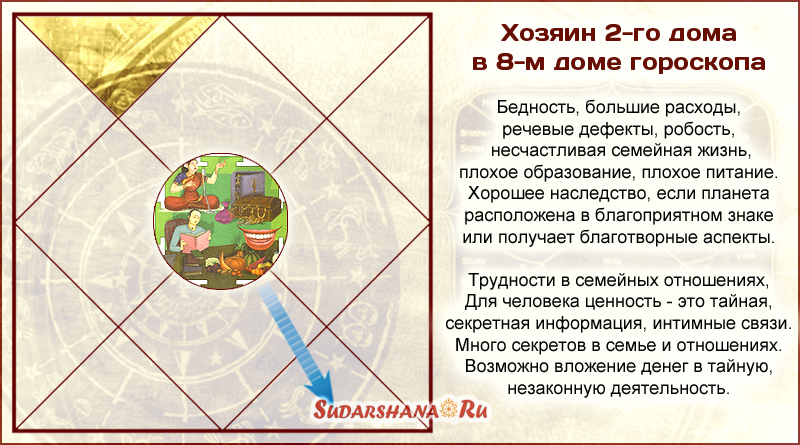
“Brihat Parashara Hora Shastra” (chapter 26): “If the ruler of the 2nd bhava is placed in the 8th bhava, then the native will be endowed with abundant wealth and lands, but he will have little happiness in marriage, and he will be deprived of happiness from an elder brother”
Comments: In this combination the native comes to own much land and wealth thanks to a will and inherited property. Even an increase of wealth after marriage is noted. Cooperation with partners and the like also helps him to become wealthy.

The placement of the ruler of the 2nd in the 8th house may give the following results:
- that which represents a value for the person — hidden, secret information, sex;
- many secrets in the family and secret relationships (members of the family in prison, misfortunes, murders and so on);
- the receipt of an inheritance (that which the person receives by means of a death)
- monetary expenditures, investments in secret projects, in secret from the rest.
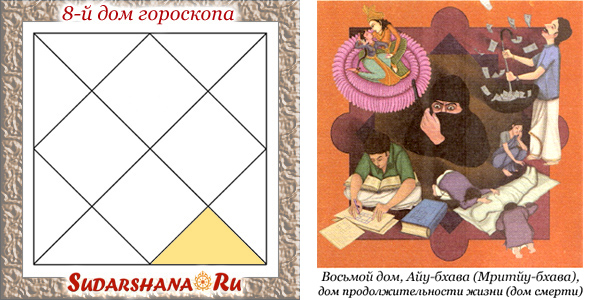
Poverty, large expenditures, speech defects, timidity, foul language, an inclination towards lying, an unhappy family life, a poor education, poor nourishment, complications with the right eye, earnings by means of undesirable or illegal methods are possible, a limited imagination, a good inheritance if the planet is placed in a favourable sign or receives benefic aspects. (James Braha)
This person suffers as a consequence of difficulties in family relations; he needs to improve his habits in nourishment, has obstacles in commercial and financial activity, but may receive an inheritance or receive wealth as a gift; he may speak sharply and energetically. (Tom Hopke)
The receipt of an inheritance, a profitable but not too happy marriage, much land and other property, money does not stay for long, there is no happiness from an elder brother. With this position it is profitable to engage in a partnership business. (Shri G.S. Agarwal)
Upayas (methods of harmonisation) for the 2nd house:
- To watch over one’s diet: how, what, where and with whom we eat.
- To watch over one’s speech — respectful, reverent, conscious speech.
- To be scrupulous and honest in money matters.
- To engage in self-education and in association with wise people.
- To give children a family upbringing and education.
- To serve and worship one’s parents, seeing in them a part of God — the manifestation of the masculine and feminine Divine principle.
- To feed the poor and students.