
The lord of the 2nd house in the 1st house of the horoscope
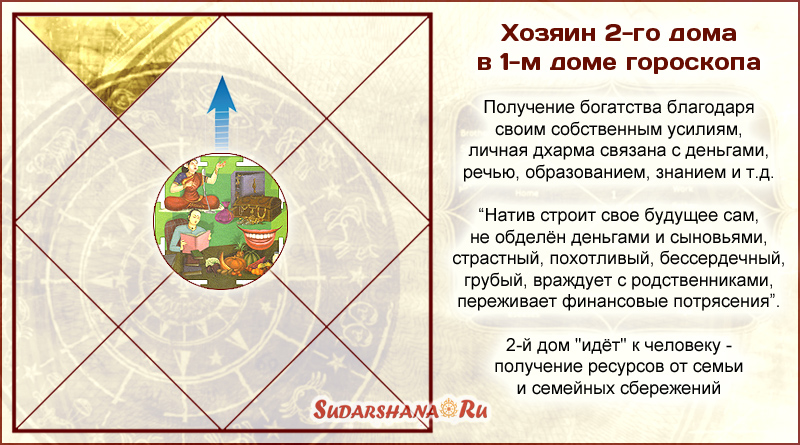
“Brihat Parashara Hora Shastra” (chapter 26): “When the ruler of the 2nd bhava occupies the Lagna, the native will have sons and wealth, he will be hostile towards his family, voluptuous, hard-hearted and will do the work of others”
Comments: The unfavourable results mentioned in the shloka manifest especially with the Kanya [Virgo] Lagna, because with this Lagna the placement of the ruler of the 2nd bhava (Venus) in the Lagna turns out to be in its rashi of debilitation. In the case of the Makara [Capricorn] Lagna the ruler of the 2nd bhava (Saturn) in the Lagna will be in its own rashi, and therefore it will give mainly favourable results
In such a placement of its lord the 2nd house “goes” towards the person — the receipt of resources from the family and from the family savings. On the other hand, the ruler of the 2nd, being placed in the Lagna, turns out to be in the 12th from its own house, draining energy from it and becoming a factor of losses and expenditures in the matters of the 2nd house.
The receipt of wealth thanks to one’s own efforts; the personal dharma is connected with money, speech, education, knowledge and so on. (James Braha);
This person is gifted with an ability to acquire money; his relations with the other members of the family are not very harmonious, he lacks good manners, he is persistent and resolute in sex. (Tom Hopke);
He earns by his own efforts, builds his future himself, is not deprived of money or of sons, is passionate, lustful, heartless, coarse, is at enmity with his relatives, goes through financial upheavals, works in a subordinate position. (Shri G.S. Agarwal).
Upayas (methods of harmonisation) for the 2nd house:
- To watch over one’s diet: how, what, where and with whom we eat.
- To watch over one’s speech — respectful, reverent, conscious speech.
- To be scrupulous and honest in money matters.
- To engage in self-education and in association with wise people.
- To give children a family upbringing and education.
- To serve and worship one’s parents, seeing in them a part of God — the manifestation of the masculine and feminine Divine principle.
- To feed the poor and students.