
Isaac Newton
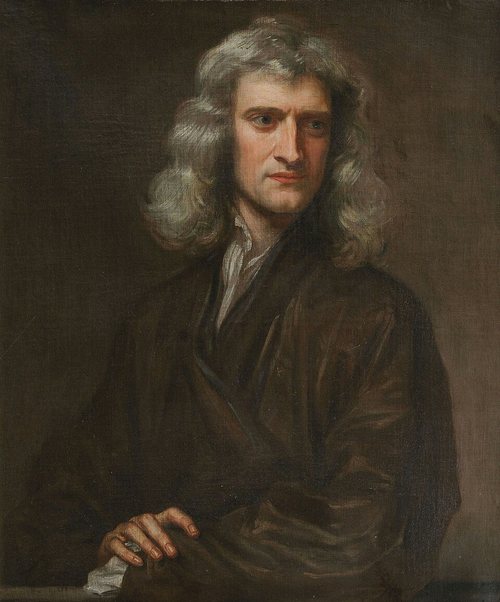
A premature baby nobody expected to survive grew into the man who set the shape of physics for two hundred years. He sat out the plague years of 1665–1667 in the countryside and said later that this was when he devised the calculus, split white light into colours with a prism and first reckoned what holds the Moon in its orbit. The “Principia” (1687) brought the falling apple and the turning planets under one law. After that came the Mint, where he hunted counterfeiters in earnest, the presidency of the Royal Society and the bitter dispute with Leibniz over priority in the calculus. Half his working life went not to physics but to alchemy and the interpretation of biblical prophecy, and he left more manuscript on those than on mechanics.
He was born at Woolsthorpe in the night of 4 January 1643 by present reckoning: England still kept the Julian calendar, where the date of his birth was 25 December 1642, Christmas Day. The hour, 01:38 local mean time, comes from a horoscope drawn in his own lifetime rather than from a document.