
Makaranda Sarini, 1923 edition
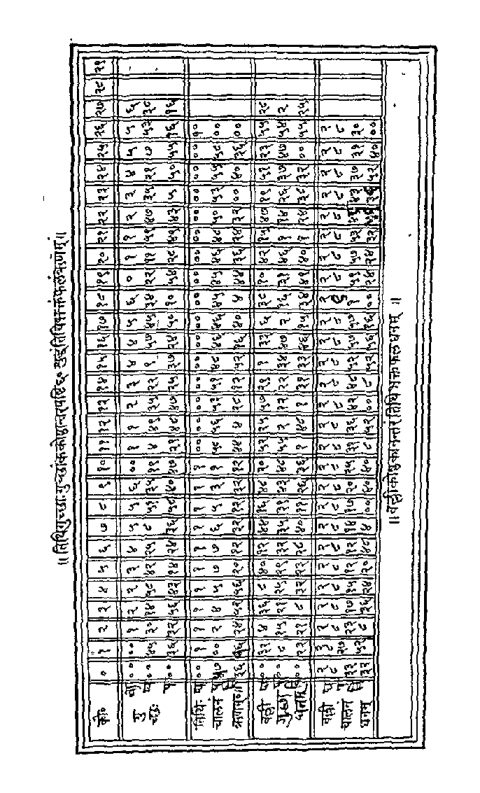
Makaranda, son of Ananda, composed his tables at Kashi (Benares) in 1478 — Saka 1400. He says so himself in the first verse: 'based on the Surya Siddhanta school of thought, properly for the benefit of the world.' The tables circulated widely and for four centuries were the principal computational aid of the Saurapaksha; part of the Indian almanac tradition still computes by them.
For our engine this proved to be a key source, and it was arithmetic, not reading, that revealed it. For four planets we carried corrections to the mean longitude fitted blindly against a corpus of charts: Mercury +6.1047°, Jupiter -3.0527°, Venus -4.5786°, Saturn +4.5761°. Their ratios turned out to be exactly -8 : +16 : -12 : +12 — integer corrections to the revolutions in a mahayuga, and precisely those that stand in Makaranda.
More than that: the common factor named the epoch. If a correction is computed once and frozen, the factor equals the number of years from the start of the Kali Yuga to that epoch, and all four planets gave Kali 4579 — that is Saka 1400, the year the book was composed. A scan of the common epoch against the corpus puts the minimum in exactly the same place, to a tenth of a year.
So four fitted constants were replaced by one date and an integer table. One remains open: neither Makaranda nor Dikshit gives Mars a correction to its revolutions, yet our computation needs one — +1°23'30". It must therefore come from the kshepaka, the epoch position in the tables themselves, and that is what we are looking for in this book.
The 1923 edition, eighty-nine pages. The scan has no text layer at all: the tables are set in Devanagari numerals and do not yield to recognition. The pages are read by eye.
Details: 89 pages, 2.2 MB.